Chloe
-
Posts
3 -
Joined
-
Last visited
Everything posted by Chloe
-
Hi Redbeard, Thanks again for the advice on the wood fibre vs. PIR. I’ve drafted the following and see if you have any comments. Thanks! North Walls (Lounge/Master Bed): 40mm Wood Fibre + 15mm Lime Plaster (~0.65 U value). This is the max I can go while keeping the shutter hinges functional. North Window Reveals: 10mm Aerogel + thin-coat lime (~0.8 U value). Essential for a thermal break without blocking the shutters. East Wall (Lounge): 60mm Wood Fibre (~0.48 U value). Since this is a flat wall without any window, I'm pushing for better performance here. Finish: Parge coat for airtightness, mesh-reinforced lime plaster, and Claypaint/Silicate paint throughout the insulated zones. Ensuite: 20mm Jackoboard (XPS) (~0.95U value) Primarily for waterproofing and as a space-saving tile-backer. Does this setup look reasonable to you, or am I over-complicating it with the different thicknesses? My current builder is great but has zero experience with wood fibre or lime. Is this a "learn on the job" kind of task if they follow the manufacturer's guides, or is the risk of interstitial condensation/poor airtightness high enough that I should insist on a specialist for the insulation phase? Do you have any recommendations for reliable wood fibre merchants that deliver to the Greater London / SE area? Thanks for your advice again!
-
Hi Redbeard, Thanks so much for the detailed replies—and for the correction on the dew point! That makes complete sense. By adding thick internal insulation, the original brick gets much colder, increasing the interstitial condensation risk if moisture gets through. Your point about the shutter boxes is exactly my fear (creating a massive cold bridge). I am definitely planning to use a high-grade insulant there to stop condensation. I'm looking at something like 10mm Spacetherm WL (Aerogel) for the reveals and shutter boxes. As you mentioned, it won't hit the 0.30 U-value (Thanks for the correction on the U-values!) but hopefully, it warms the surface enough to prevent local mould. This brings me to the Building Control aspect you rightly pointed out. Because I physically cannot hit 0.30 W/m²K in the bay windows without destroying the functionality of the integrated shutters, do you find that Building Control is usually open to granting a 'waiver' (or accepting an area-weighted U-value calculation) for these kinds of original/fixed features? Regarding my original question about the exterior pebbledash: my main concern with using Kingspan/PIR on the flat walls isn't just that the bricks are leaky, but that the existing cement pebbledash is highly impermeable. If any moisture gets into the brick (or gets trapped during construction), it’s sandwiched between PIR foil on the inside and cement render on the outside. Does treating the pebbledash with a breathable hydrophobic cream (like Stormdry) mitigate this risk enough to make PIR a sensible choice? Or, in your experience, is Wood Fibre (with no VCL to get wrong) really the only 'fail-safe' option for a cement-rendered solid wall? My main concern is that my builder has no experience with wood fibre or lime plaster, and I'm worried that a poorly-installed breathable system might be more dangerous than a standard PIR system he knows how to install correctly. Thanks again for your time—it's incredibly helpful!
-
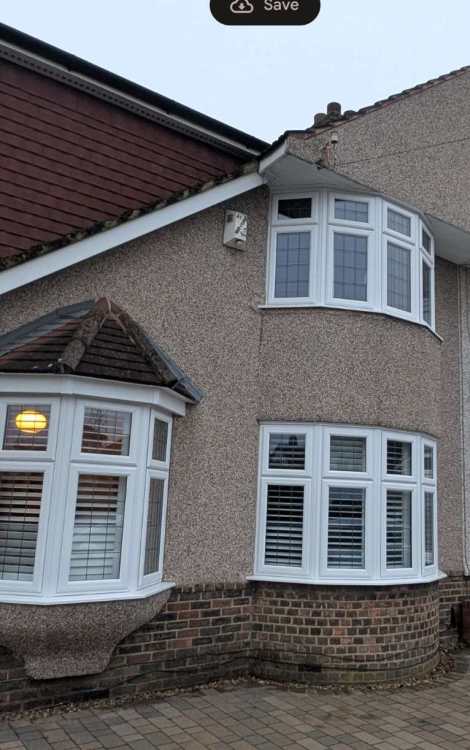
Hi everyone, I’m new to this forum and are looking for advice on an internal wall insulation (IWI) project for a 1930s semi-detached chalet. It has original solid brick walls (no cavity), but a complex mix of exterior claddings on our freezing North-facing elevation. The Setup (North-Facing): Ground Floor (Lounge): The exterior has an exposed original brick plinth at the bottom, and cement pebbledash on the upper half. Inside, there is a large original-style bay window with integrated shutter blinds. First Floor Right (Master Bedroom): The exterior here is entirely covered in cement pebbledash. Also has a large bay window. First Floor Left (Ensuite): This has a unique diagonal split exterior—the top half is vertical tile hanging, and the bottom half is cement pebbledash. Inside, we currently have severe black mould in the shower area on this external wall. My Dilemma: My builder has recommended Kingspan K118 (PIR) drylining for its high U-value and thin profile. However, I’m highly concerned about trapping moisture behind a non-breathable foil-backed board, especially where the exterior is wrapped in waterproof cement pebbledash. I'd love your thoughts on these three specific issues: 1. Breathability vs. PIR: Given the cement pebbledash, would a vapour-permeable system (Wood Fibre + Lime Plaster) be definitively safer for the ground floor Lounge and the Master Bedroom to prevent interstitial condensation? 2. The Bay Window "Shutter Trap": I have integrated shutter blinds in the bays. If I use a breathable wood fibre system (typically 60mm+), the shutters will hit the new thicker walls and won't fold back. Has anyone safely used a thinner PIR board here by applying a breathable hydrophobic cream (like Stormdry/ProPerla) to the exterior pebbledash? Or is Aerogel the only safe thin option? 3. The Mixed Ensuite Wall (Jackoboard): My builder suggested stripping the mouldy ensuite wall back to brick and using Jackoboard (XPS) to create a waterproof, insulated "warm box" for the shower. Since the exterior of this specific wall is half breathable (tile hanging) and half non-breathable (pebbledash), is sealing the inside with vapour-impermeable XPS safe for the brickwork across both of those exterior finishes? Any advice would be hugely appreciated! Thanks so much!!