dwtowner
-
Posts
10 -
Joined
-
Last visited
Everything posted by dwtowner
-
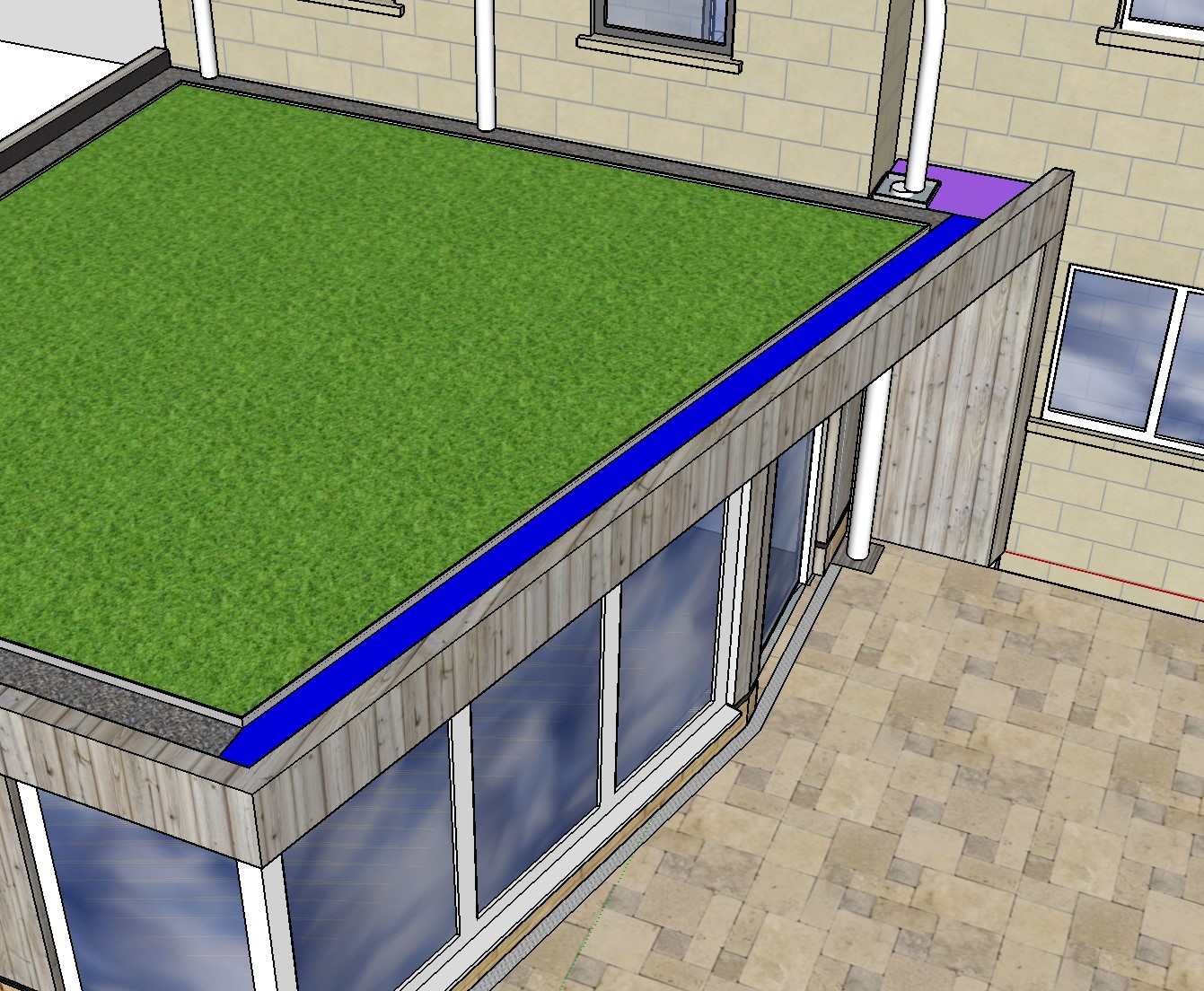
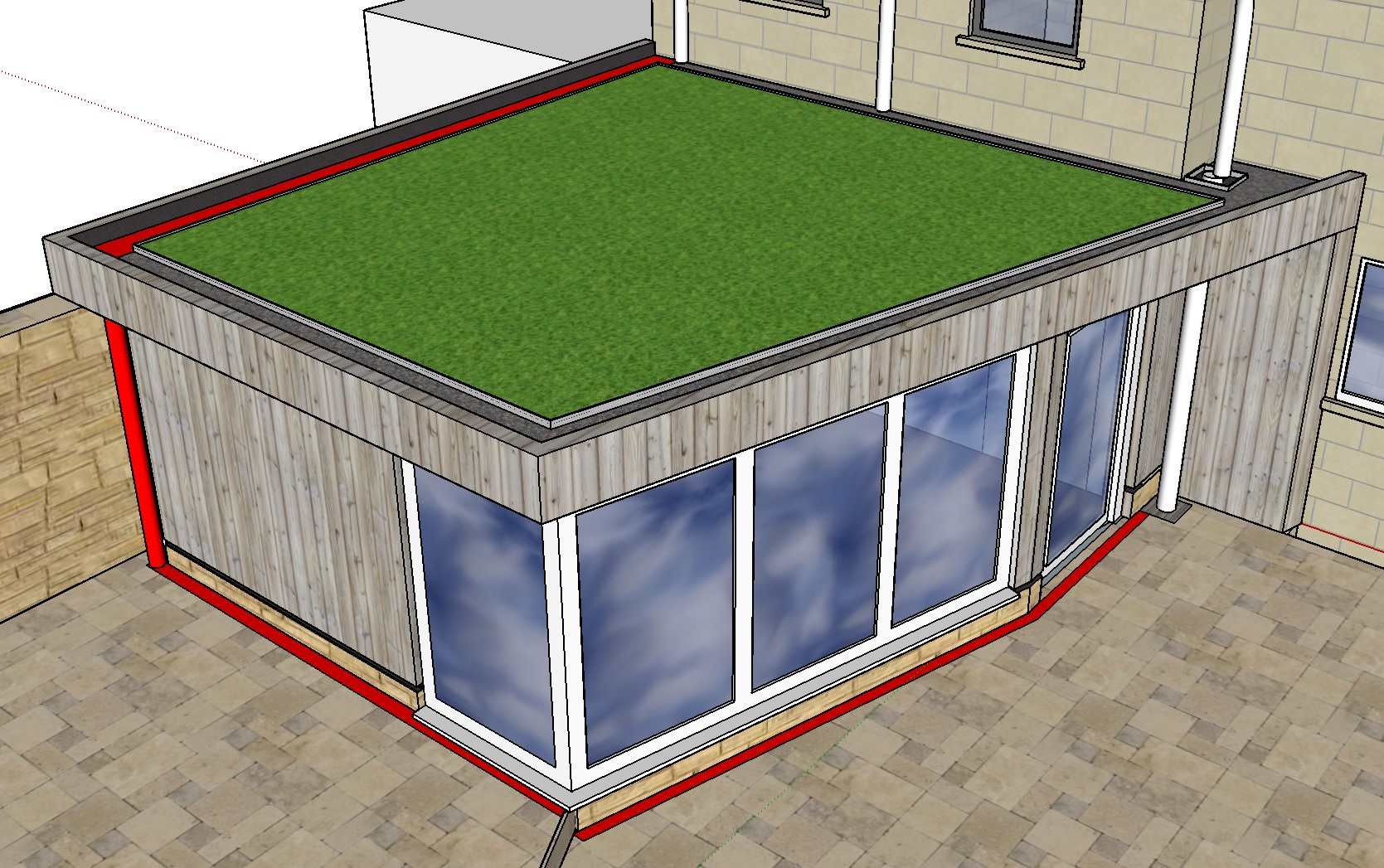
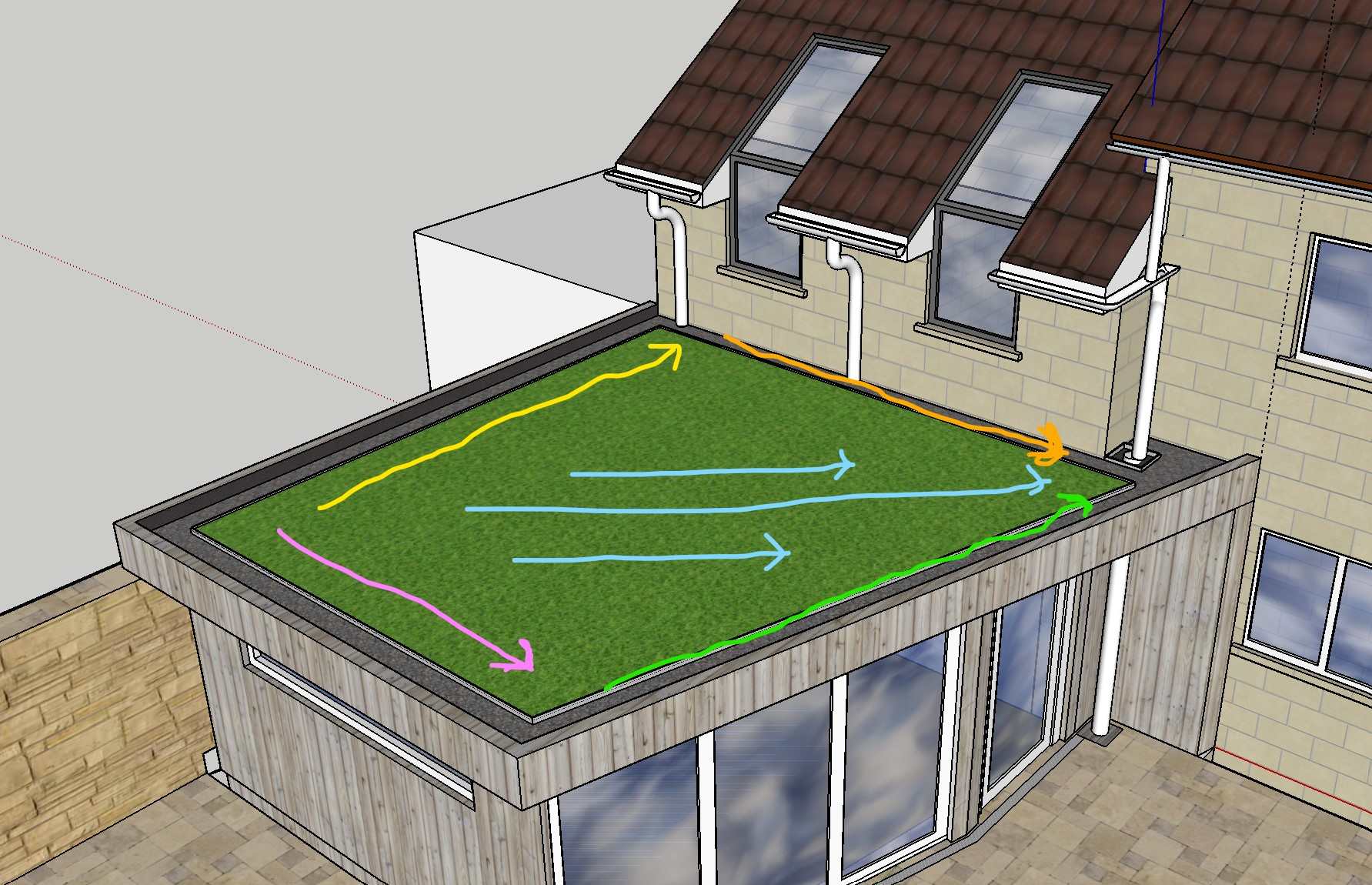
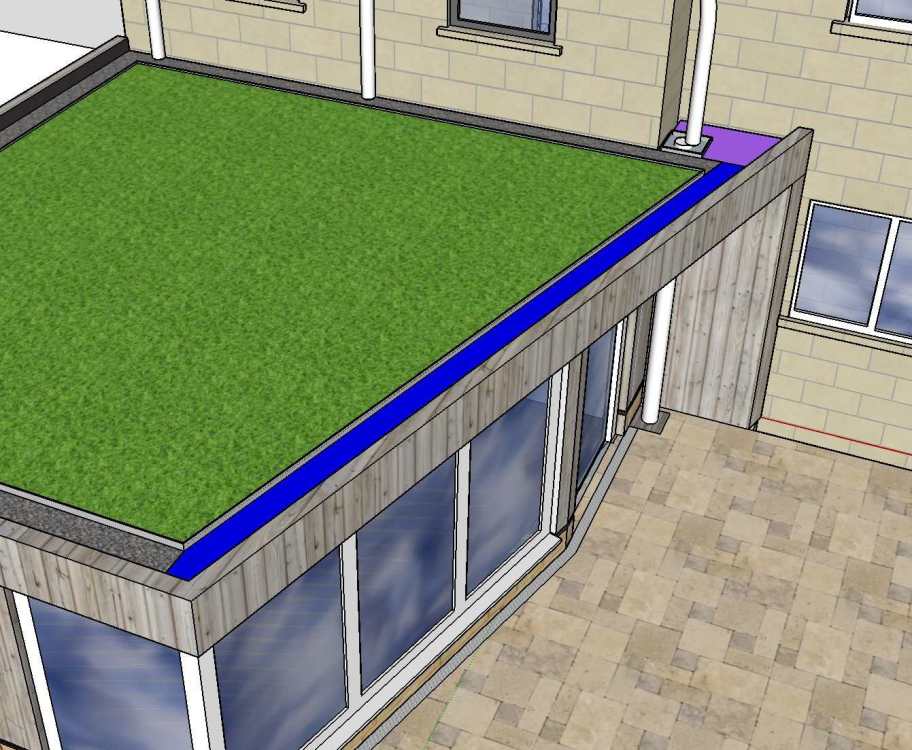
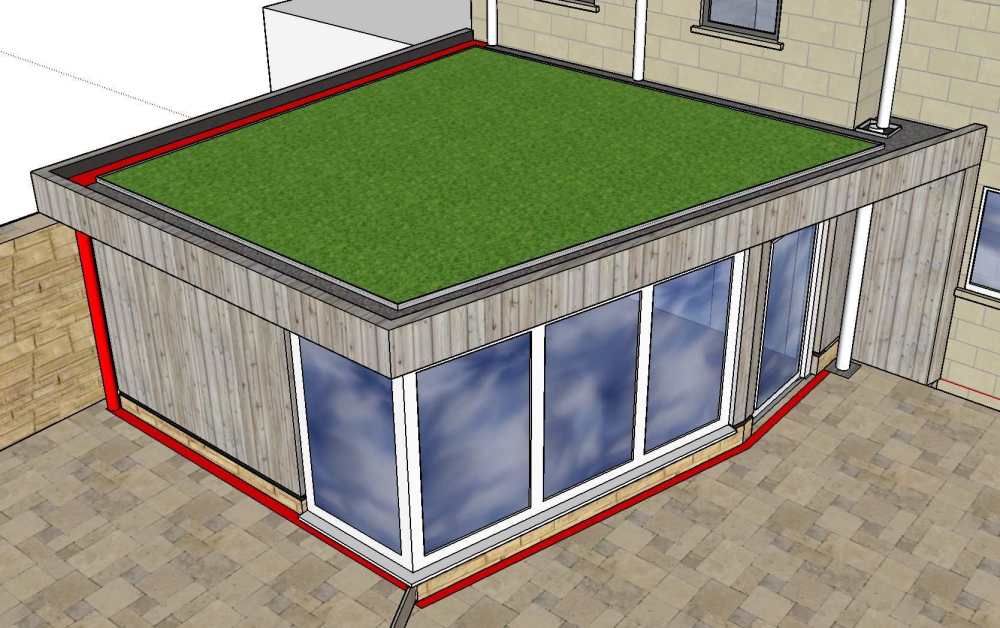
@Gus Potter Thanks for the interesting link to the privacy document. I've already got planning permission, so I'm going to stick to the dimensions I gave in that. I've been using the terms internal, hidden or concealed gutter, but maybe they have specific meanings. What I suppose I really mean is a conventional green-roof gutter (e.g., https://radmat.com/eshaflex-green-roof-edge-detail-5/), with a wooden trim hiding the actual gutter from view. The underside of the trim could have vent holes so that even if the gutter overflowed it wouldn't fill up the trim, and overflows would visibly drain out down the face of the building, not inside it. As it would be concealed from view it could be oversized. Would that work, or is that still prone to problems? I don't have any tree near enough to cause leaf blockages of the gutters. I've been playing around with the details of putting the gutter along the front or back of the building. I've attached two drawings showing the routes. If I went with the red route, the roof slopes toward my neighbour into the gutter, then via a downpipe into a slot drain running around the perimeter of the building. I need a slot drain anyway for the glazing (which might turn out to be lower than I've drawn it). From what I've found out about slot drains they are allowed to be dual purpose like this, and it should easily carry the volume of water, especially if the green roof is slowing the water down too. Being on my neighbours side would make cleaning the gutter, and seeing any blockages, a little harder. If I went with the blue route the roof would slope towards my glazing and into a gutter running above the glazing. I could make the entire section in the internal corner of the house essentially a big hopper (the purple box) with an overflow and a grill on top to allow stones to conceal it. Do both proposals work? Is there a reason to prefer one over the other? I could build either within the dimensions set out on the plans. For the downpipes off the main roof, would it be sufficient to put an open box gutter (e.g., Lindab's rectangular series) on the roof surface to catch the water and direct it to the nearest gutter, or would it be better to have a solid pipe connecting the bottoms of the downpipes to the gutter? Thanks as ever.
-
Thank you everyone for the comments. I take on board the various points made. I'm having fun trying to do the entire extension myself, from planning to construction, so I welcome your help in understanding what to do better. @saveasteading asked for my reasoning for some decisions: - I will be looking out onto the roof from my office windows (the pair of Velux Elements), and the rest of my garden is much higher than the house so will be looking down on the roof. I wanted something attractive to look at, and a green roof is better than 24m^2 of EPDM or GRP. My planning application decision notice did mention that the green roof was a positive point (although they didn't say why!) - would they hold me to it? - My neighbours house is considerably lower than mine and I want to keep the height of the extension as low as possible to avoid having too big a mass on the boundary, and avoid too much overshadowing on winter days. I can see a pitched roof could be a better solution, but in the interests of neighbourly relations I'll do what I can with a flat roof. - All the existing drainage (soil pipes, inspection chambers, gutter down pipe) are already in the internal corner of the house, which is why I routed everything back there. If I pitched the roof towards the boundary with my neightbour, I could put a concealed gutter along that edge, and a down pipe to the left-most corner. It would put the fall at its lowest too, which minimises the height for my neighbour, and might allow me to have a greater fall too as I can tweak my parapet to hide the bigger height. It would mean having to run another drain pipe around the entire perimeter of the building to get back to the existing drains though, but I'm landscaping the surroundings anyway so maybe that isn't a problem. I do like @Gus Potter 's solution too - pitch toward the glazing with a hidden gutter, and make the internal corner the drain with an overflow. It keeps everything on my side of the house rather than my neighbours (maybe not an issue though), and ties into the existing drainage provision. Downside would be that the roof would be at its maximum height on my neighbours side where I really want to minimise the height.
-
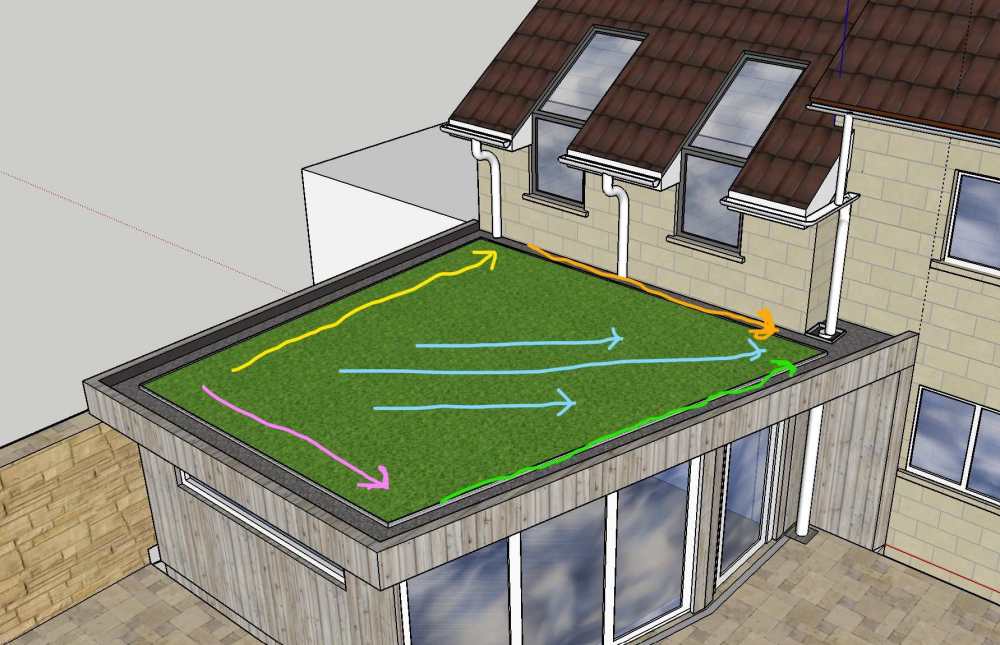
I am building a single-storey extension with a green roof. I want to understand the best way of managing the falls. The attached image shows the proposed extension against my existing house. I already have a downpipe in the angle of the main house on the right hand side with all the associated manholes etc beneath it, so I want that to be the lowest point of the roof with a suitable drain to take the water from the flat roof. There are a couple of other small gutters which would need to discharge onto the roof and be directed into the same drains. I think that there are 3 ways of laying the falls: - have a channel (with fall) along the edge of the house (orange), taking the existing downpipes to the drain in the corner, and have the rest of the roof laid to fall in the yellow direction. - have a channel (with fall) along the front of the building (green), with the rest of the roof laid to fall in the pink direction. - lay the falls in the blue direction between the left hand corner of the roof and the opposite corner where the drain is. Is there an obvious answer of which is best, please? Is it worth using tapered insulation boards, or stick to firrings with a board overlay? Ancilliary question: In the past I've seen something like a downpipe that goes through a flat roof, taking water from above and guiding it through the roof, while also allowing water from the flat roof itself to enter the downpipe from a hopper in the flat roof, but I now can't find anything like it. Does such a thing have a name? I've drawn what I think it should roughly look like in my diagram. thanks, dan.
-
Walnut tree. Underlying clay soil with high water table/springs. Sloped ground with terracing/levelling made from spoil from the original construction. It's the screw pile companies own SE. The screw-pile company provide a complete solution for the foundations - design, calculations and approval for BC, install. I'll construct the building myself on top of those foundations - I've done several previously - but just want to get one company in to do everything necessary for the foundation, and I'll go from there. Is that a bad thing?
-
Thanks for the advice, everyone. I should have said that the outbuilding pre-dates the house and is built on a thin raft foundation which is at the wrong height to marry up to the FFL in the house. 3 of its 4 walls are in the wrong position too. It is easier to make a clean slate of it and start from a new foundation which is at the position and height I want. Even with the wall in a new position I will still have an 80cm gap between my house and the boundary, so I won't lose any access, but that was a good point.
-
It's my tree, right on the boundary. My neighbour acknowledges it is mine and that I can remove it if necessary. The SE knows that the tree is there. They will be using a screw pile system designed for use in root protection areas, so there will no digging. As they are a professional from a reputable company, I trust their opinion. But if you think there might be a problem, then maybe BC will too, and I'm curious how that will play out as one professional opinion against another. I assume BC can ultimately override the SE?
-
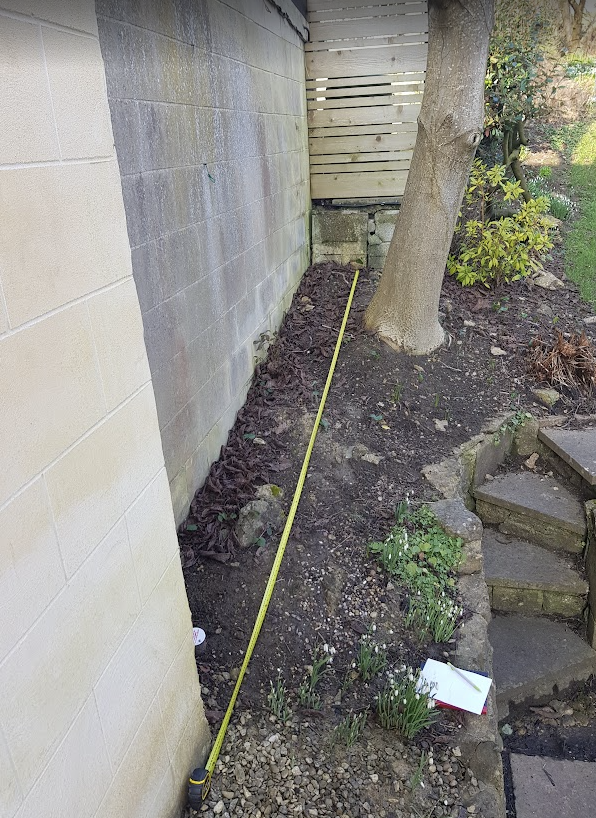
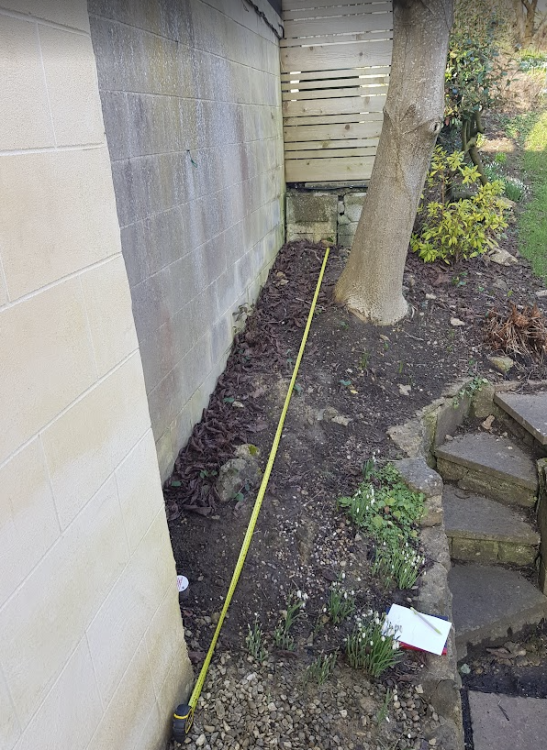
At the back of my house I have a basic block outbuilding that I have permission to replace with a single-storey SIPs or timber-frame. There is a mature tree near the outbuilding, and the new extension will be slightly bigger, which will bring it closer to the tree. The photo below shows my existing house on the left, then the outbuilding to demolish, and a yellow tape marking where the wall of the new building will be.The property boundary is the wall where my notepad is resting. My existing house is already on piles (poor ground), and a structural engineer has designed a piled foundation for the new extension which takes the tree's presence into account so I hope that building control won't raise any issues with the foundations. If a structural engineer has designed the foundations and done everything to account for the tree, can BC still object to it? Are there other issues which I haven't thought of that might make it better to remove the tree as part of this work? I am really reluctant to remove the tree because it provides much needed privacy between me and my neighbour, and shade for us both, but if I'm storing up future trouble then maybe now is the time to remove it. thanks,
-
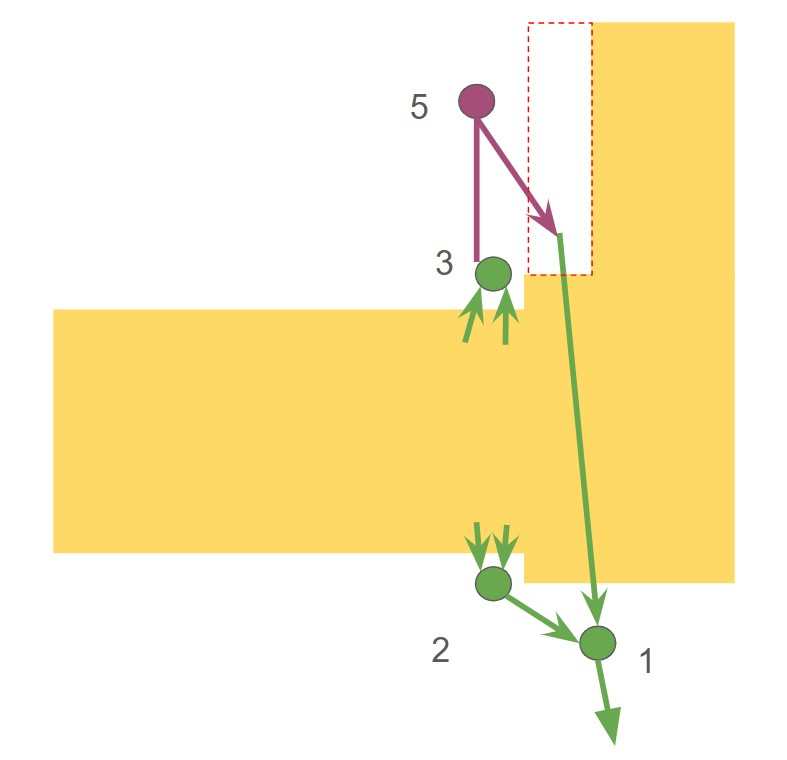
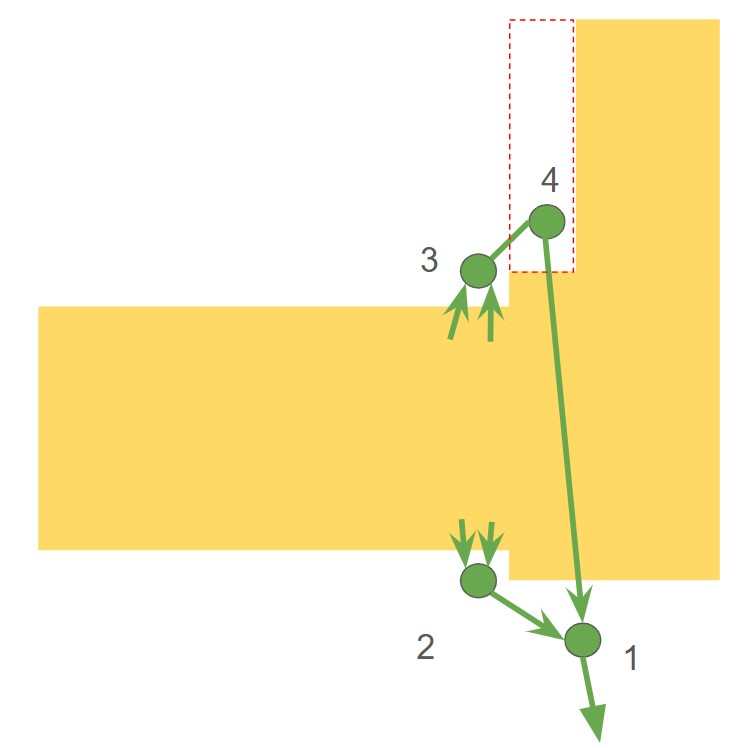
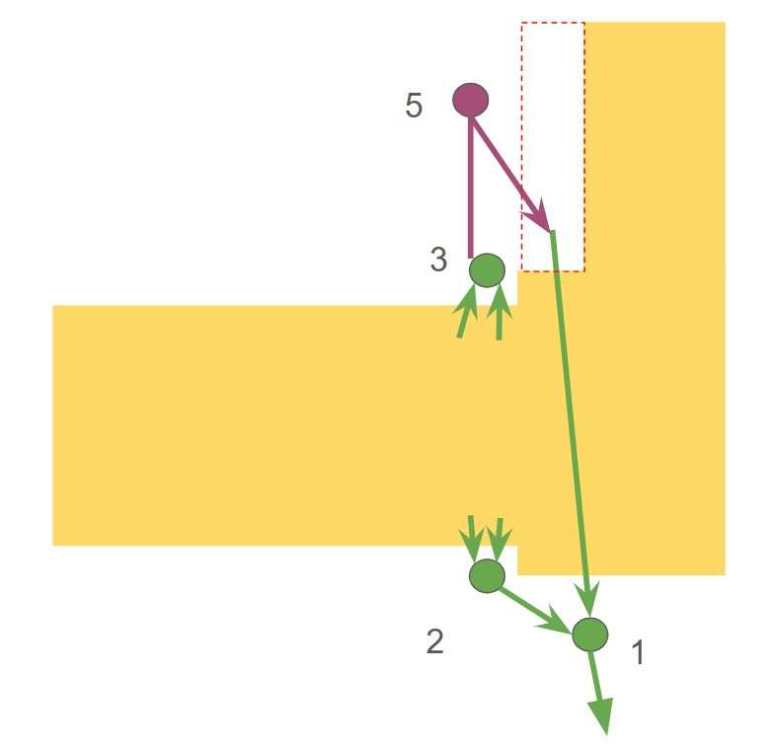
I want to build an extension to infill a corner of my house but there is an inspection chamber in the way. I'd like some advice on what I might have to do to fix this, please. My house is laid out as shown in the first diagram. Yellow for the house, green lines for drain runs (with arrows for direction), and green circles for the inspection covers. IC 1 is the last chamber before it goes off to the mains. IC2/3 take the soil pipes from the house, and the gutters. IC4 provides a rodable change of direction. The pipe between 4 and 1 is approx 9m and is a single run through the foundations. I want to infill the red dotted area (approx 1m wide) , which will be directly over IC4. I don't want to have to leave an access hatch through the floor of the extension to maintain access to an IC in that position. I think that I will have to move IC4 so that it falls outside the red dotted area. Putting it directly in line with the existing long run would put it too far away, but if I put a shallow (<30deg) bend in I could keep it reasonably close to the existing IC. I've drawn this in the second diagram in purple. Is that right? Are there any alternatives? Thanks.
-
Options for building extension on existing outbuilding foundation?
dwtowner replied to dwtowner's topic in Foundations
Thanks for your comments Nick. Some useful prompts to think about things again. A few responses. This will be the third SIPs extension to my house, which itself is very insulated, triple glazed, etc., so I think it is in proportion. I've had a very positive experience with SIPs so far - a kit of parts arrives, all nicely numbered, and up it goes in a day or so. I take your point though that maybe its overkill for this slightly smaller extension. The old garage was lower than the existing house so the extra 40cm brings the floor to the same level. thanks, dan -
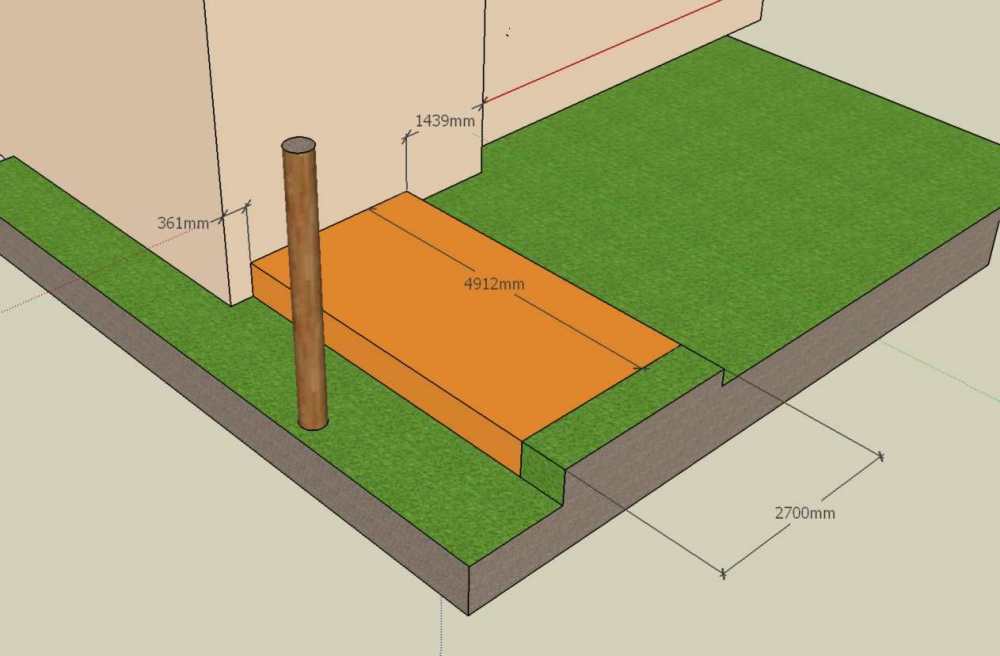
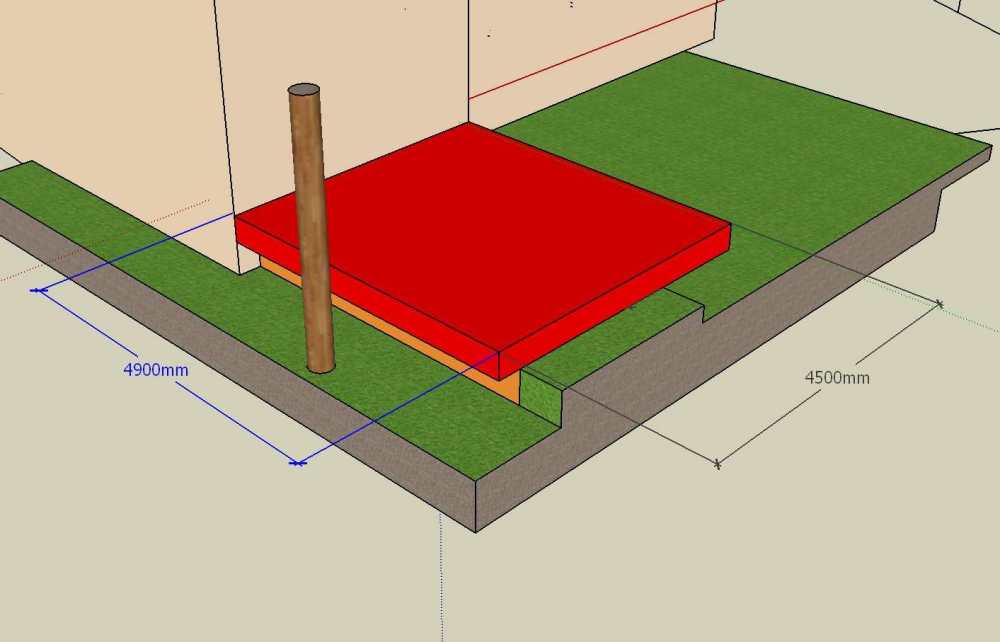
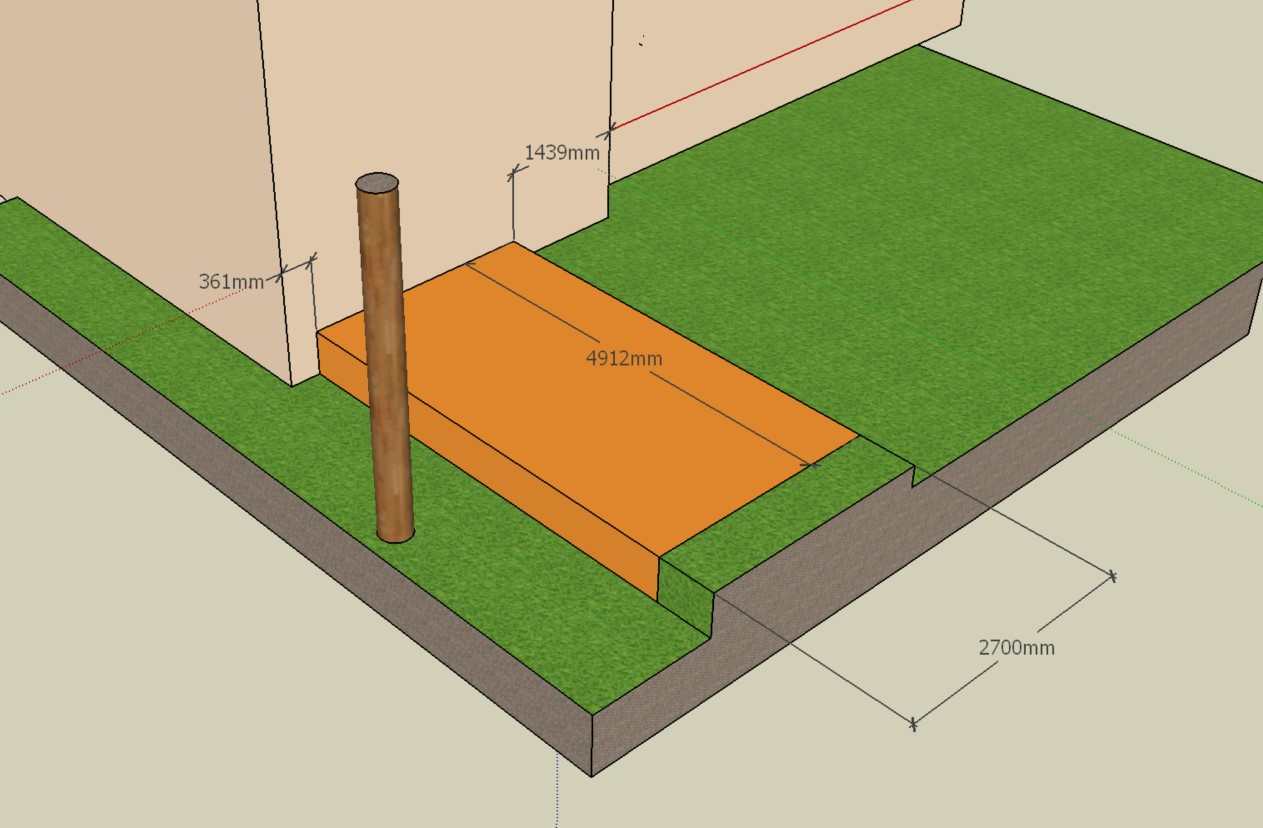
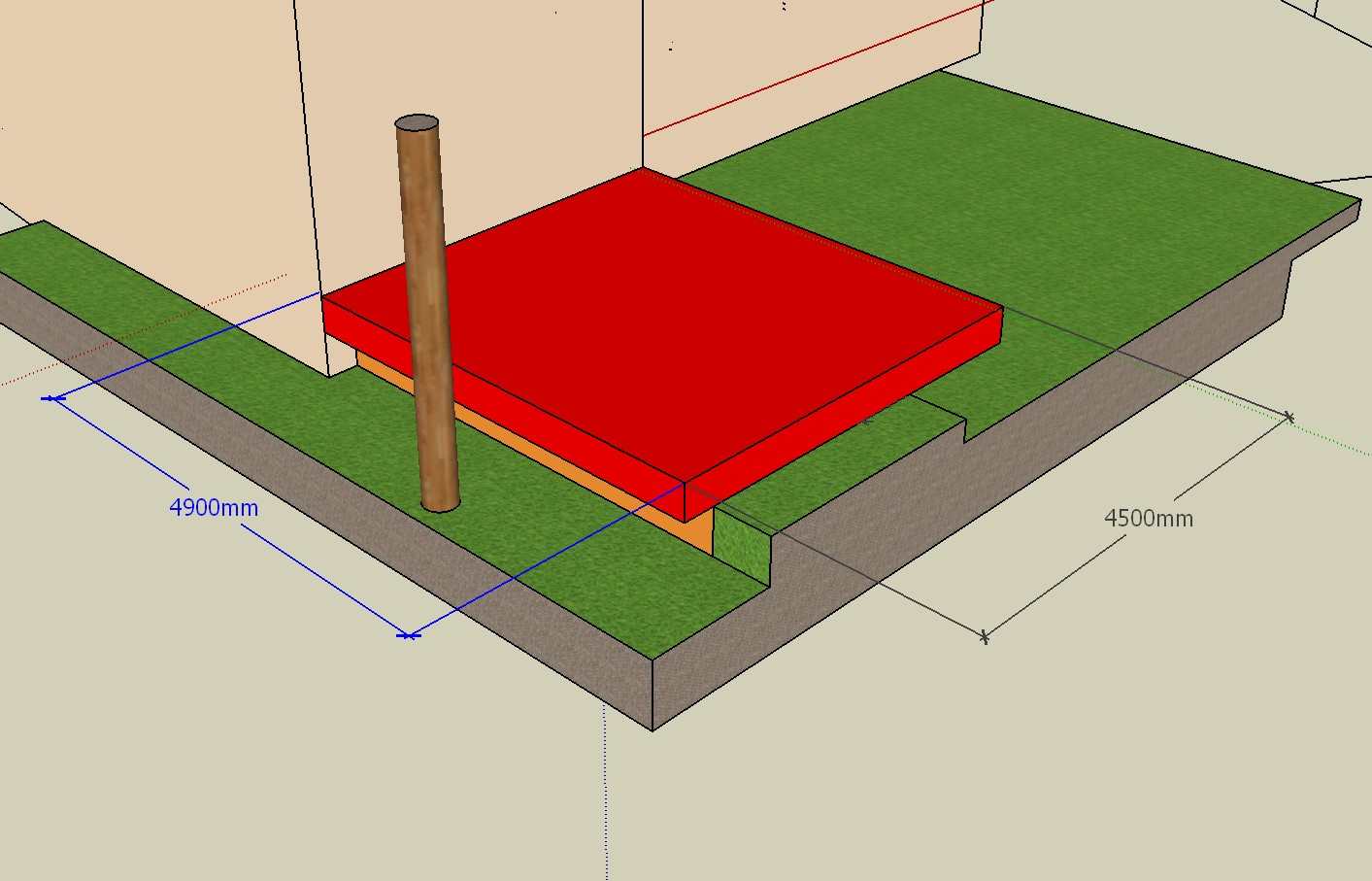
I have a garage-sized outbuilding behind my house for which I have PP to convert into a room, built using SIPs. The existing garage has been there for about 70 years and doesn't have any cracks or issues that I can see with its foundations. The attached diagram shows the existing foundation in orange, relative to the house and surrounding ground. The other attached drawing shows the footprint of the new building in red. The new building will be about 40cm higher than the existing foundation. There is a mature self-seeded Walnut tree about 1.2m from the foundations which our neighbours are very reluctant to remove (technically it is mine so I could, but I quite like it there too). The edge of the left-hand green strip in the diagram is the boundary with my neighbour. There is limited access - about 1.2m width - for heavy machinery to get to the site. I'd like to understand what the options might be for extending or replacing the foundation to make it suitable for the new SIPs room. 1) Rip out the old foundations and pour new foundations. Clean slate to start with, but requires the tree to go, and is very disruptive for the neighbours during the work (their house is only a few metres away). Difficult to get machinery in and spoil out. 2) Leave the existing foundation but use ground screws across the site (through holes drilled in the old foundation) and around the perimeter of the new building, and then put a wooden insulated structure on top to support the SIPs. The tree could stay, and there is less disruption from removing the old slab. 3) Could the old slab be reused, with some new structure built partially on top of it? On the right of the diagram I think I would need to ground screw or do conventional foundation to support the edge, but could I cantilever off the left-hand side to avoid having to do anything else near by neighbour, and to avoid removing the tree? I've got about 40cm height to play with 4) Something I haven't thought of? Finally, any recommendations for a SE who could help with this, in the Bath/Trowbridge area? thanks, dan.