jakeR
-
Posts
5 -
Joined
-
Last visited
jakeR's Achievements

New Member (2/5)
0
Reputation
-
Noisy clicky corrugated metal roof- please help!
jakeR replied to jakeR's topic in Roofing, Tiling & Slating
Good resource, thank you. I did use mastic tape but only one strip per join so there is quite a lot of metal to metal contact beyond the joint. These documents seem to suggest two would be better. -
Noisy clicky corrugated metal roof- please help!
jakeR replied to jakeR's topic in Roofing, Tiling & Slating
Thank you for the suggestions so far. It's hard to tell exactly where the noises come from but my best guess is that it is from where the sheets overlap each other, as standing on the overlaps can produce a similar sound. There are some sheets that overlap quite a bit so that i didn't need to cut down the length of the sheet, which may also be an issue. Maybe a test setup is required... I'm also wondering if it could be to with wind as there is currently a lot of airflow as I haven't done the soffits or fascias yet- (there's a bit of pressure to move out of my mother-in-law's house and into ours so was hoping to leave this till later!) I did wonder about this @Mr Punter but could this cause condensation problems for the timber or the roofing sheets? Would the rockwool be laid on to top of the horizontal battens and the tin on top? I wouldn't mind refitting them if it would help. Thanks -
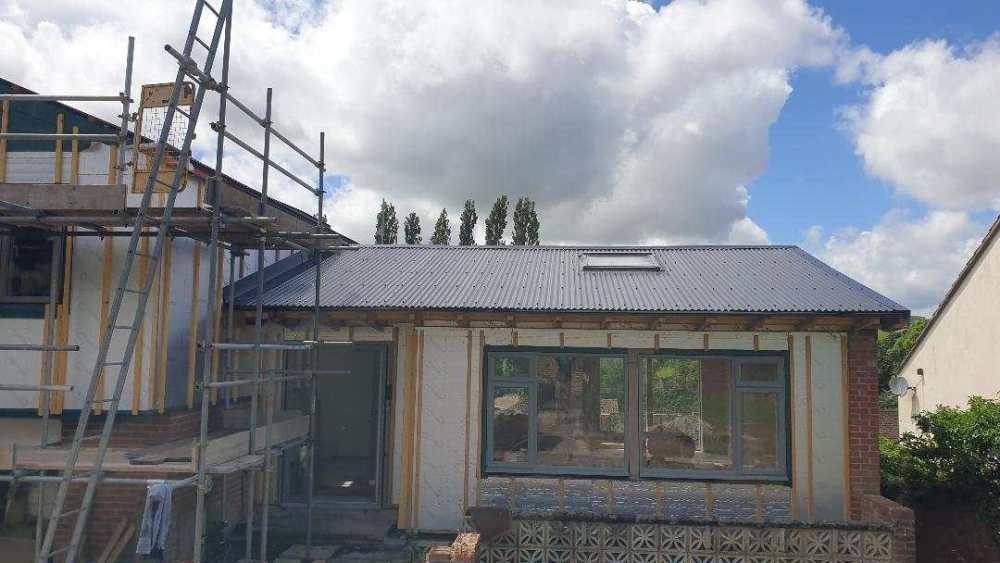
Hello, I have been doing a refurbishment of a 1980s timber framed house and have replaced two roofs with black 13/3 corrugated steel. I'm very pleased with how it went and how it looks, however... it is noisy! I was warned that it would be louder in the rain but it is not that significant and I quite like that sound. It is, however noisy when the sun hits it and there are pops and clicks all over the roof, I think caused by thermal expansion. I would expect this to happen a bit but it really is very noticeable and when there is intermittent sunshine it happens a lot. One of the roofs is a (celotex) warm roof and so the noise of this travels inside quite effectively. I'm supposed to be cladding some of the walls in the same corrugated steel but am loathed to do this until I've figured out how to mitigate this. A bit of googling suggested that it may be do with the fixings being overtighted but I just had a roofer look at it and he thought they looked fine. Anyone had any experience of this or have any suggestions about how I might be able to fix it? Painting it all white would help I guess but I really don't want to be doing that! For context the layup of the warm roof is: Corrugated steel fixed with 65mm BAZ screw from Cladco 45x70mm timber batten breather membrane 45x70mm timber counter batten 200mm PIR insulation Alutrix 600 vapour barrier 18mm Plywood original 38 x 100mm timber trusses The cold roof is the same but minus the PIR vapour barrier and plywood deck. Any help would be very much appreciated. Thank you.
-
Hmmm, very interesting, thanks! The top layer of OSB was really just for walking round on while I did the rest of the roof but it would save a grand or so not having it. Perhaps I can omit the top breather membrane as well? The idea behind using the Alutrix Vapour barrier is that the roof is watertight from this point which will help in construction. I'm replacing the roof on existing roof trusses so am unfortunately stuck with the top cord, hence the additional batten. I would much rather not use the thermally broken fixings as they are expensive and look a bit fiddly to use. I was worried about thermal bridging but don't really know what difference this will mean in the real world, so maybe normal screws will be just fine. I've not seen 45 degree battens before so that could be good. The roof currently has a reasonable overhang at the eaves (I'll post some photos) which I will probably keep. I was hoping to do something clever where I can trim the trusses back outside the building so that the overall thickness of the roof doesn't look too chunky from the outside.
-
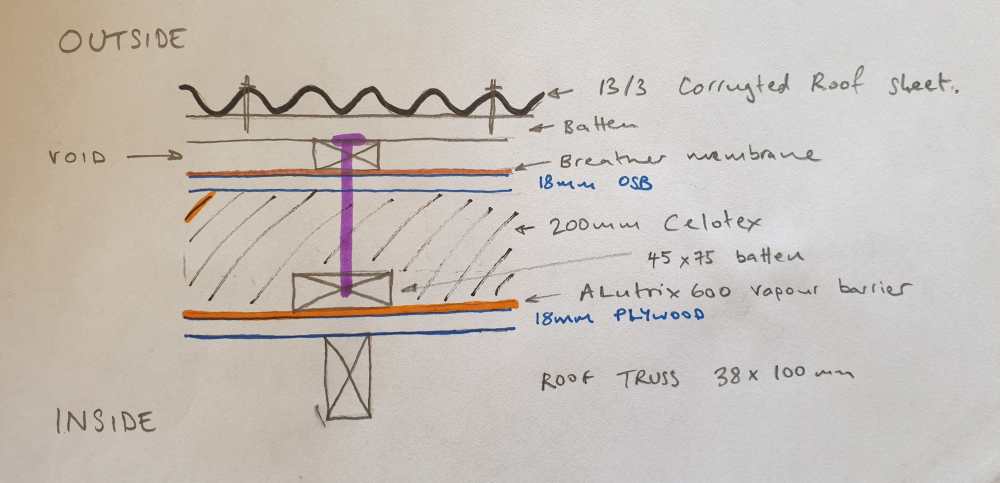
I am in the process of refurbishing a 1980s timber framed house and will be replacing the existing (knackered) tiled roof with a pitched warm roof finished with 13/3 corrugated metal. I've attached a drawing of the proposed layup of the roof (which I hope is clear enough!). The roof trusses will be left exposed and the bottom layer of plywood will be fireproofed and lacquered and will be left visible from the inside. As the roof trusses are a pretty skinny 38mm, I'm planning to screw a wider vertical batten above the plywood into which the layers above will be fixed, as I don't fancy my chances of hitting the trusses with screws through 200mm of insulation. I'm looking for some advice on the fixings to use and how many. I was planning on using thermally broken fixings as shown in the purple in the drawing, going through the counter batten, osb deck and PIR insulation- which would need to be about 250mm long. However, I'm wondering if I can just fix the OSB deck in this manner and then just screw the counter batten into the OSB? If it's sufficient to just fix the counter batten to the OSB, then can anyone give me a ballpark figure for the spacing/number of screws needed or how to work this out? Any tips on thermally broken fixings and screws for the battens also would be much appreciated. Many thanks. (Apologies, if this has been covered before and thanks for all the amazing advice from everyone I've read so far!)