


YodhrinForge
-
Posts
60 -
Joined
-
Last visited
Everything posted by YodhrinForge
-
Okay brief background - property is circa 1900 semi-detaches stone cottage with early-mid 90's extension/attic conversion, slab in the latter suspended timber in the former. Building is getting an EnerPHit-style eco retrofit with all the proper vapour open materials wood fibre yadda yadda. Original plan was for new insulated slab floors with underfloor heating throughout but the project is going through a bit of the old "value engineering" at the moment and my current instinct is to cut down to just the kitchen extension and treat the existing suspended timber floors with a special system that uses a vapour open but windproof membrane to seal the floor structure(allowing them to still dry out to the solum cavity), then wood fibre batts between the joists, then a vapour barrier on top before application of the subfloor. My one reservation about this is it's a former shale oil mining area and so there's a possibility - albeit a small one - of elevated levels of soil gasses and radon. The inhabited space will have MVHR so I'm probably just being paranoid, but I'd rather do too much now when everything's being taken apart anyway than find out come next winter there's an issue and have to dig everything out again. The solid floor plan would have involved a ventilated sump and radon-rated DPM and while I *might* be able to use one of those as the vapour barrier(yet to hear back from architect about it) I still think I'd like to increase the ventilation of the subfloor space as right now there are only three grates(imagine division between the two properties as interlocking L shapes, mine has the narrow front and wide rear so one front vent two at the back). The actual question then: There are two chimney flues originating in the downstairs front & back rooms which I wanted to close up anyway, so I wondered, could extending the flue down into the subfloor space with some ducting and sticking anti-backdraft caps on the chimneys provide extra passive ventilation via stack effect creating a stronger draw on the space? And if that could work, is there a process and what sort of ballpark price could I expect to pay to have the interior of the chimneys coated with something like a Visqueen liquid gas barrier(no point removing any potential radon from the subfloor just to let it diffuse through the completely vapour-open wall buildup into the interior anyway)? I've seen companies that will do a concrete-ceramic spray coating for chimneys with active fireplaces in them, but I've no idea if that sort of equipment would work and if any would be willing to run something else through them.
-
I'm aware. The Diathonite was planned anyway for the exterior walls inner face, and to be applied thicky both to level, decrease the chances of cracking in future which would compromise the airtight layer, and for its excellent wicking and moisture management properties. And while the cost isn't small, in this plan for the adjoining walls it would be somewhat offset by dropping the inner layer of rigid insulation I had thought to add behind the stud wall. Anyway in the end it's all subject to WUFI/PHPP modelling anyway, I'm just trying to get an idea of how to balance everything optimally.
-
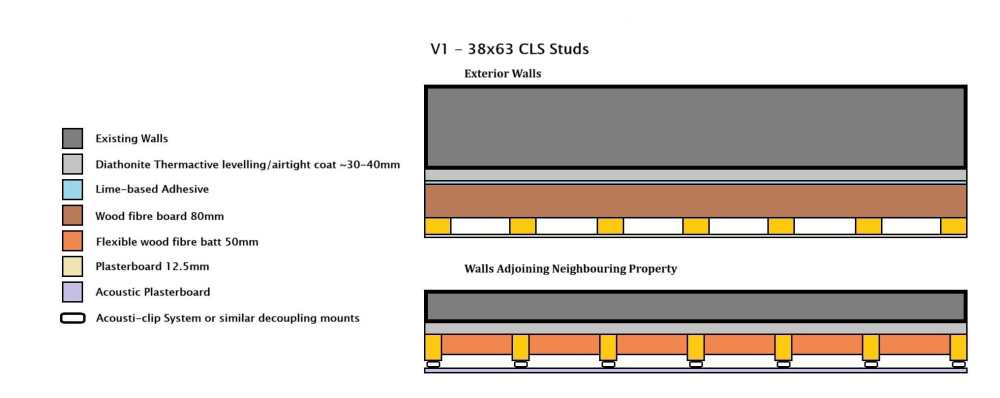
Having finally found some more detailed reference material, I've amended my buildup again(turns out Diathonite Thermactive has a final density of 250kg/m3 +/- 15%, which is basically double rigid wood fibre, so pushing that from a ~30mm parge/levelling coat to a ~40mm base layer will do both the extra mass and thermal decoupling adequately).
-
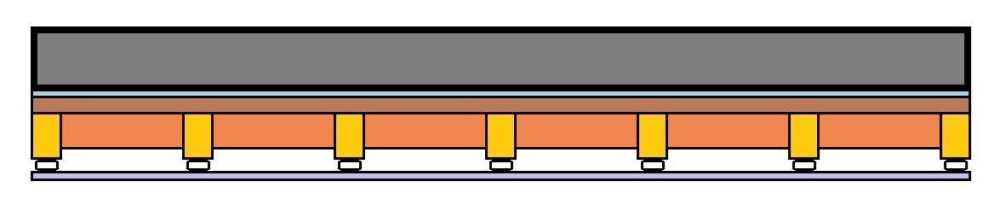
I'd considered using flexible batts, but the wall will be getting coated with some kind of lime-based material anyway as that will form my airtight layer(using enerPHit principles, just not fussed about getting the certification), I also have to be careful about managing dew point and avoiding unintended cavities. How about the pictured; lime parge/adhesive > 20mm rigid wood fibre(thermal break) > stud wall w/ 50mm flexible wood fibre between > clip & rail system > acoustic plasterboard. When it comes to the floors, whichever solution I go with will be carried through the floor as much as possible to achieve continuity of insulation and airtightness, and I was intending to use a sound dampening subfloor for any suspended timber flooring. There's also the benefit that the run of the joists is front-to-back while the neighbouring property is to one side.
-
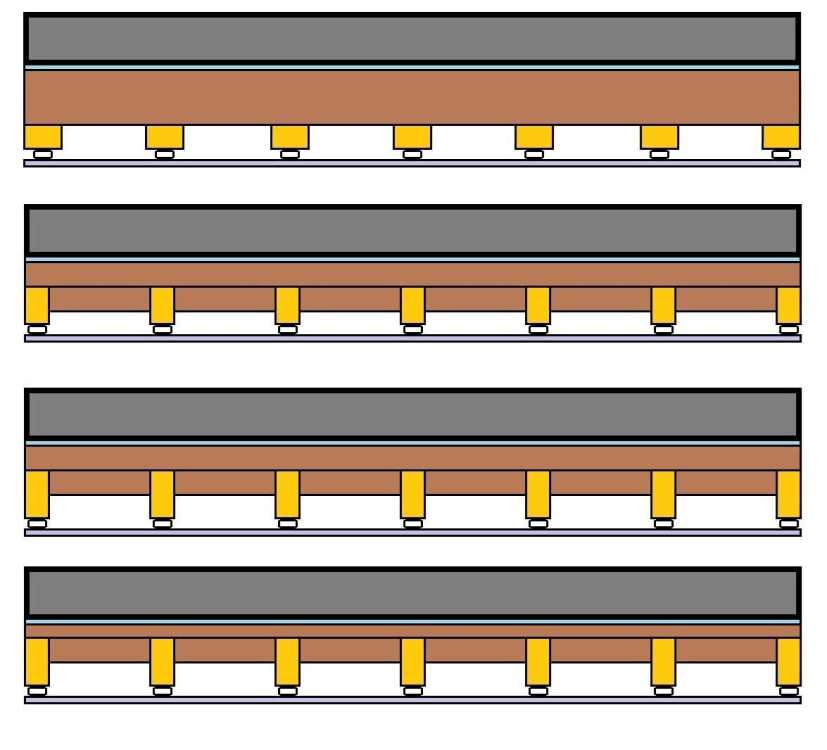
The physical decoupling occurs in the decoupling system I mentioned, one of the polymer mount & channel type systems for fixing your plasterboard to, the insulation layers are for thermal performance and mass(rigid wood fiber has a similar or better kg/m3 than the best acoustic-rated rockwool and I'm using it on my exterior wall interior facings for insulation anyway). I'll be stripping all exterior and adjoining walls to the masonry to add vapour open airtightness, insulation and, for the adjoining walls, soundproofing. Here's a shitty MSpaint of what I've been discussing with the architect. Top to bottom on the buildup is existing wall, lime adhesive, wood fibre, stud wall, decoupling system, acoustic plasterboard. The variations are just different thicknesses of wood fibre(top to bottom 80mm, 40+40 between studs, same, and 20+40 between studs) and sizes & layouts of CLS(top two 38x63, bottom two 38x98), which I end up with will depend on space constraints of the final designs and what the structural engineer wants. Second one down seems the best compromise of depth, mass, & thermal performance to me. Oh and for clarity I say excessive because the existing wall is two rows of brick in a circa 1900 stone building, so you already have to pretty much be *trying* to be loud to annoy each other, I just figure that since I'm pulling everything down for airtightness & insulation work anyway I might as well see how I can tweak it to maximise acoustic performance too.
-
There are a few decent calculators out there online that let you get a very rough ballpark u-value for whatever your wall buildups are going to be, I'm wondering if there's anything similar for wall buildups designed for acoustic mitigation? I'm a big fan of over-designing rather than dancing on thin margins so I'm less interested in the exact precise values for a specific actual wall than I am in whether the general buildups I'm considering(current lead contender is existing brick partition wall>40mm rigid wood fibre boards with adhesive & hammer fixings, CLS stud wall in contact with previous, further 40mm wood fibre depth between studs bonded to initial insulation layer, then some kind of decoupling system with acoustic plasterboard mounted to it) will be sufficiently excessive.
-
I'll remember to remember that tip thanks No this is me going back & forth with my architect trying to find something with the right balance of cost, risk, time, DIY-ability, and likelihood of getting past BCO/planning/whinging council conservation officers. As for the service cavity: it's more convenient, future repairs/modifications are easier, and it lets me use the plasterboard approach which for me will be a lot cheaper as I can do it myself. I'll ask the architect about the model, and the other suggestions received thanks to all. Just to be clear neither of the alternatives actually have been modelled for this property and only the latter(clayboard & clay plaster) has been used(and modelled) by the architect before, the membrane solution was something the architect got back from a potential "eco" building supply place we were considering using for the raw materials, and I wanted to see if there was a way to stick with my original plan before faffing about running more models.
-
I refer to it that way mostly because most of the youtube tutorials I found were yanks and they rarely do anything else by all accounts, whereas all you hear about on UK property shows when I was growing up was plastering. Anyway, I appreciate the link but that's actually one of the things I read that encouraged me that plasterboard would work in the first place. Unfortunately the modelling of my intended buildup says that even the small additional resistance of gypsum board over clay or similar is enough to cause a slow accumulation of moisture in the wall over time even with fully vapour open paint used internally, so I'm not sure what to believe except that if the modelling is right then in a few years time I'll have to rip out all the work I'd done and do it again so it seems safer to look for alternatives.
-
Still trying to figure out the specifics of my eco retrofit of a circa 1900 stone cottage, but I've been slightly buggered by the WUFI modelling. Based on what I'd read previously I believed taped & jointed - American style - thin gypsum plasterboard with vapour open paint would be sufficient to allow the internal wood fibre insulation and the stone wall to breathe properly, but Computer Says No apparently. Previously planned buildup was external lime harling > original stonework > up-to 30mm Diathonite levelling & airtight layer > 100mm rigid wood fibre > ~40mm stud wall to create service cavity with spaces infilled with flexible wood fibre > 12mm plasterboard > clay paint, however the modelling suggests this would accumulate moisture over time despite proper MVHR to manage internal humidity - slowly, but in a few years or certainly a decade or two I'd be having issues. The two suggested alternatives suck for different reasons; either adding an Intello membrane between the rigid wood fibre and the stud wall, but this would require dropping the flexible wood fibre filling out the spaces in the stud wall which is a noticeable reduction in u-value; or switching to clayboard with clay plastering for the interior instead of plasterboard, which has sufficient permeability to avoid the buildup issue but uses up a bit more internal space given it's thicker and would require me to fork out for a specialist plasterer to do the mesh-reinforced binder coat and the skimmed finish coat, which ain't cheap. I found *one* company offering what appear to be lime-based plasterboard substitutes designed to be very vapour open but still work pretty much exactly like common gypsum board, but they're only just starting to roll out the product and aren't selling to the public yet, and I can't imagine that a small house renovation will get through their application process to be a demo project(not to mention that as it's brand new there's no track record to look at, could be a complete dud in practice). Are they genuinely the first to come up with such a thing? Standard plasterboard was appealing exactly because with the tape & joint method I could do it myself and achieve pretty nice results for just material costs, while still maximising insulation, so any alternative that let me do something similar would be ideal.
-
I have to replicate the appearance, not the exact scale. There were bigger iceboxes and smaller ones, that one just happened to have the right layout and relative proportions to illustrate the point. Also, it's not a massive household, if we could manage with a regular freestanding fridgefreezer - and we could - I'm pretty sure we'd be fine with a larger freezer, a slightly smaller fridge, and an extra minifridge. It might end up rivalling one of those American style monstrosities in size once the cabinet is built but we have no need of that kind of capacity. Could we maybe possibly start with the assumption that I'm not a total numpty with no idea how much space he needs and circle back to the questions asked?
-
The job spec from The Boss is to try and replicate this kind of thing: Originally the upper left from the photo's perspective would have been filled with a big honkin' block of ice and that would have cooled the other compartments. The reason I was hoping to bodge it using freestanding units is simply that we're going to need appliances for the next god knows how many months while I do the retrofit that was the original point of buying the house, and I baulk at the notion of buying perfectly good appliances only to probably give them away in a few months and buy even more. With free standing units they can be used in the meantime and then when the time comes to deal with the decor I just have to figure out remounting the doors so they look right while still closing properly.
-
I'm aware you can't use actual traditional radiators with a low temp heatpump driven system, but I'm wondering if anyone knows if there's such a thing as a low temp radiator that is *styled* at least somewhat like old Victorian cast iron units? Searching myself has yielded only either modern looking low temp units or actual Victorian salvage, but these days who can tell if that's because what you're looking for doesn't exist or just search engine enshittification.
-
It has been Decreed that once I finish retrofitting the new place for energy efficiency and comfort, it must be decorated in "simplified Victorian with periodesque kitchen" style to match the restored original exterior of the building. Can't say I'm upset, never much cared for modernist minimalism anyway. That said, pinterest is a curse from the devil, because now I'm expected to create a ****ing wooden icebox cabinet-styled fridge-freezer setup for the kitchen. No way in buggery am I paying for a restored antique with modern innards, so it'll have to be faked - a narrow freestanding freezer, freestanding under-counter fridge, and a minifridge would actually replicate the door layout on some of the examples of the originals I've seen if arranged bigfridge over littlefridge one side, freezer the other, so my two questions are: 1; am I right in thinking that as long as the heat exchanger coils are on the back of the units and I maintain adequate ventilation at the rear of the cabinet, boxing them all in should be okay? and 2; I know there was a refactoring of energy efficiency ratings a wee while ago because everything was being rated some variety of A and several pluses, but now everything just seems to be rated E instead so I'm not sure how that's helping people choose between specific units, can anyone recommend actually-efficient versions of what I mention above?
-
Do affordable(to buy) work towers exist?
YodhrinForge replied to YodhrinForge's topic in Tools & Equipment
Brilliant notion thanks chief, even brand new those are much more in the realm of what I had in mind costwise. I might even keep most of them for future DIY stuff. Thanks for the offer but alas I'm in Edinburgh and don't drive. -
My project is going to involve me working extensively up and around some old 3m victorian ceilings(stripping popcorn if it tests negative for asbestos, cutting out strips of the lath around the room perimeters to carry airtight and insulation layers through to the floor above then making good with plasterboard, fixing new cable conduit, plumbing pipework, and MVHR ducting, then constructing and attaching a new false ceiling to conceal all of it) and being both a hefty chap and a bit of a klutz a platform with stabilizers seems like a much safer choice than teetering on a ladder. Then I started looking around for one and jeezo, 600+ quid including VAT for even the most basic shortest one with no stabilizers or wheels?! More like 1200-1500 for a heavier duty one with stabilizers and a little extra height. Am I looking at the wrong thing or is that about what I can expect to pay no matter where I look? Because I'm pretty sure I could fab something similar with a hundred quid's worth of tubular material and a couple of hours stick welding, so what am I paying for with those things, a wee sticker on the side saying it meets some certified specification?
-
Mmm yes, because the government have been so effective at "nudging" other necessary changes. How are those "reduce car miles driven by 20-30%" targets going... As expected, once in power Labour begin talking out of the other side of their face - the only "climate action" they're interested in is locking up grannies longer than they would if they'd stabbed someone for sitting on a road, and the only "voices for change" their ears can hear are industry lobbyists. People in England are beginning to grasp something a lot of Scots have known for years now: Vote Labour, Get Tory. One way or another. And London Bubblers will still stare at each other in bewilderment when polling puts populists who at least *pretend* authenticity ahead.
-
Air/vapour coated OSB for habitable loft?
YodhrinForge replied to YodhrinForge's topic in Lofts, Dormers & Loft Conversions
Pretty sure there's more to passivehouse-approved products with proprietary coatings than just slapping a coat of paint on it. -
So there's a possibility I'll have to do my renovation project all in one go rather than bit by bit while living in the house as I'd originally planned and I'm considering what the most cost effective and convenient accommodations would be if I do. I have a double garage on the property to store all my crap in so it's just a place for my own carcass I need to consider - renting a flat nearby would cost me 800-1000 a month which isn't ideal, so I was wondering if anyone knows approximate costs for renting those little "pod" things I've seen at a few sites for longer term workers that are like, a single bed, a desk, a shower room, and a tiny little kitchenette that they just crane off the back of a truck and you plumb it in to amenities on site? I can find prices to buy them(yikes) but as usual for rentals everyone want to take all my personal info to give me a specific quote when I'm still at the stage of considering general options and just want a ballpark figure to see if it's worth considering. I expect there are minimum periods etc, but just an idea whether it would be cheaper than renting a whole flat for say, six months would be useful.
-
Part of the project I'll be doing at my new house is upgrading the existing loft conversion, part of which will require tying the airtight layer upstairs into the wall parge downstairs and also aiming for low vapour permeability(as opposed to downstairs, where I'll be going fully vapour open with lime/clay - pending computer modelling of dew points etc - due to the stone walls) since sadly I'm limited by the conservation area to staying with room-in-roof as I can't alter the roof's external size or shape to make a warm roof. I've seen a few youtubers using, internally, an OSB product with a green coating that ostensibly allows it to be air tight and very vapour resistant(once properly taped) that seems like it would be way faster and more convenient, especially as a DIYer, than wrestling with membranes and battens but all the applications I've seen it used in are walls - has anyone used it in roofs, and if so what did you think? I know that in principle a timber roof is just a timber wall on a slant so it should be fine to use, but some firsthand knowledge would be welcome.
-
Dealing with the cavity is one of the things I've gotten useful into about here previously, and also one of the reasons doing insulated slabs instead is appealing if I could cost them out right. As far as I can tell my best option would be to duct in fresh air to two or three points around the perimeter and then run an extract duct up the disused chimney and whack an anti-backdraft cap on there and rely on passive stack effect/wind draw to pull fresh air in through the supply ducts. The exterior walls are almost half a metre thick so I'm not going to get any air bricks down there except in the internal partitions. I've not checked the condition myself yet because given the amount of work and that I'll have at least some pro trades on site I need to have the full "destructive" survey done for asbestos, so they'll be putting holes in the walls and floors I can use to inspect afterwards. Yeah I'd hoped to have more of a plan in place before I went to an architect but I suspect you're right. The heating system is just one factor in deciding which approach to take with the floors. I'm pretty set on the insulation/airtight methodology already based on my research; take it all back to bare stone, venetian lime-clay plaster as a parge & levelling coat, rigid wood fibre boards bonded to the wall with same, then a stud wall hard up against the rigid boards(services and easier finishing) with the floppy wood fibre batts stuffed in for exterior walls and the densest acoustic rockwool for the border with next door, then clayboard with more venetian plaster to finish. Fully vapour open and the plaster is both alkaline from the lime and great at wicking any moisture that does end up in the walls out thanks to the clay. House will have MVHR obviously so I'm not too worried about needing a vapour membrane but both that and the final thickness of the insulation will have to wait for detailed thermal and humidity modelling. I'll have to use membranes or green-coated OSB for the attic conversion upgrade anyway as the traditional slate construction and being in a conservation area means room-in-roof is required so that just has to be properly detailed at junctions with the downstairs walls, and I'm tempted to get some diathonite to pack in around any embedded joists before I use liquid airtightness goop to seal the joints. With the floor airtightness would either be a dedicated membrane if it remains suspended, or the DPM taped off to the parge layer of the walls if I go with solid floors.
-
I'm moving into a house that is in habitable condition but has minimal if any energy efficiency measures(stone built late 1800's cottage with somepoint-in-latter-part-of-20th-century block extension & attic conversion, approx 65sqmof ground floor is suspended timber) presently on a gas boiler with radiators. My intention is to get as close to EnerPHit as I can without spending a fortune, and I'm trying to figure out which strategies to pursue for individual elements(floors, walls, roof, heating, battery etc etc). I intend to handle as much of the renovation as I can myself, I've been researching stuff for a solid year so I know pretty much what's involved in the process of *doing* any given element, but finding even vague information on *roughly* how much one option vs another will cost is proving a pain in the backside - for example, I can roughly cost out the "insulate existing suspended timber" option as I can know exactly what materials I need to order in approximately what quantities and I'd do the labour myself, but finding information on professional costs for the job is like pulling teeth. Some sites will give you a ballpark figure(and I only need a ballpark figure, I know you need specific info about a job to give a proper quote, but if someone asks me to build them a PC I only need a general idea of their use case to give them a rough idea what sort of money it's going to cost them and getting that kind of request is completely normal in almost every "doing things for money" field I've been in or interacted with *except* building trades who seem to delight is keeping as much information to themselves as they can), but for what? "A UFH system", but is that just the pipework and labour to install that? Does it include insulation? Does it include the cost of ripping out existing flooring? I just need enough information about cost to meaningfully compare the options available, and if I went down the UFH route to decide whether it's worth buying the tools and investing the time to do it myself or to hire pros etc(I'll be working on the project full time so the usual price of my time/pay a pro calculus is a bit different to someone who'd be slogging away evenings and weekends after their regular job).
-
As title, unfortunately these days search engines just spit out 500 basically identical AI-slop "summaries" of the blatantly obvious occasionally interspersed with completely objective and unbiased examinations of the facts that always seem to think the best option is whatever one the company who made the website can sell you. I'm trying to choose between insulating suspended timber floors with membranes & wood fibre(and figuring out some way to vent the cavity as it currently isn't and the walls are half a metre of stone) with replacement low temp rads, or ripping them out and doing UFH in insulated concrete slabs, but trying to piece together a proper understanding of the costs and details is a pain in the backside(This website says That much, but is That just for the UFH tubes and a couple of lads to put them in or does it include insulation, concrete pours etc? Who knows). If there was a site that broke down in general terms pro vs DIY costings for both options that would be a godsend.
-
Unfortunately if I have the test done and they find anything, I'm no longer permitted to DIY it, you need to pay a licensed contractor and get certification etc. Doing my best, hah. I was planning to tear down the ceilings anyway as part of the retrofit, I was just hoping to do it myself like much of the rest of the work. I just started freaking a bit when nobody would give me even an idea of what the worst-case cost would be and I realized I won't even have the choice whether to DIY or not if I have the necessary level of survey done. It's a semi-detached stone worker cottage from the turn of the 19th/20th centuries, that was extended with a cavity block rear room and attic conversion some time in the first half of the 90's judging by the decor of the bathroom & kitchen and the fact the cavity is uninsulated. I don't know if there was already some of it in there from when the place was built or if it was all added with the extension, but it's on all the downstairs ceilings bar one room and the inner slopes and small ceiling of the attic rooms. Regarding the mush stuff - I thought that was only sufficient if you were subsequently going to encalpsulate and leave undisturbed whatever substrate it was on? So wouldn't really be an option for me anyway as the ceilings have to come down at least around the perimeters so I can carry the airtight layer and IWI through the floor to upstairs.
-
So I'm almost at the finish line on acquiring a house and I knew going in that it had been renovated pre-2000 and has artex ceilings so it was a good bet there was some asbestos there, but honestly I'm starting to freak out a little and I'm wondering if I've made a stupid decision. Not because I'm afraid of the boogeyman substance, I know how dangerous it is but also that properly handled it can be dealt with safely, but rather because I'm concerned I might screw myself by getting the testing done. All the firms I've approached have said I'll have to do the full invasive survey because I'm going to be doing some renovations that will have trades on site and once you have that done it's done, on record, so you either pay to have every last shred of the stuff scoured out of the property or the stain of it is there forever, you have to say Yes on the forms when you sell, you have to get regular reinspections done on anything that was encapsulated etc. The worst part is none of the firms who do removal in my area will give me even a vague ballpark figure for how much it could cost me in a worst case scenario until *after* the testing is done at which point I have no choice but to pay them to do it, since having the works & demolition survey done means you need a full action plan filed with the government and must use the licensed firms to deal with it. I've seen some discussions online talking about spending a couple of grand and others saying it could cost 50k+. The present owners have made it clear they won't accept an offer subject to the test, so the risk will be all mine.
-
Explanation of situation follows, skip to the next paragraph for the specific problem if you DGAF. I'm currently running through all the various scenarios of how to efficiently(and cost-effectively) insulate, airtight, and heat my new-to-me late 1800's stone cottage. My initial plan was to rip out all existing suspended timber and break up the existing concrete kitchen extension floor then put in proper insulated slabs with wet UFH, however I'm toiling a bit to figure out how I can handle that all mostly DIY while also living in the property, not to mention the cost which looks to be almost as much per-room as it would be for the materials to do the whole suspended timber floor and slap some phenolic boards on top of the concrete in the kitchen. Not ideal but a significant cost saving. The plan would be to use vapour open membrane to make "cradles" between the joists to fill with wood fibre batts, then an airtightness/vapour control membrane over the top, then a 50mm rigid wood fibre tongue & groove layer to act as a subfloor and level it with the phenolic-topped kitchen floor. I should be able to address the doorway heights largely by fiddling with the trim. The issue this raises however is the solum. Like all these old solid stone wall buildings the space under the floor is intended to be ventilated by the open fireplaces sucking moisture laden air through all the gaps - in this case, between floorboards - in the house and shoving it up the chimney via stack effect and convection. Needless to say when I'm trying to create an insulated airtight mechanically ventilated living space I don't want to deal with cold damp air from the ground underneath, but I'm toiling to figure out a simple solution. I certainly want to avoid knocking holes in the walls near ground level. All I can think of is to run some supply pipes from outside(the back wall of the house has already been opened up in a couple of spots thanks to the late 20thC extension so I should be able to find somewhere to slip a few pipes through) to the front & back of the house, run an extract pipe up the disused chimney, and try to cram a few air bricks into the partition walls below the bottom of the joists so that air can move across. Does that sound practicable, or is there a simpler solution I'm not aware of?



