Sunil237
-
Posts
51 -
Joined
-
Last visited
Everything posted by Sunil237
-
Kitchen sink drainage directly down in slab or outside?
Sunil237 replied to Sunil237's topic in Waste & Sewerage
Thanks @joe90 that's helped me figure out the plan @Temp unfortunately it's not that he's forgotten.. he just didn't know the correct way so it's going to be upto me to spot these things earlier as we go through. Luckily not the end of the world, as his scope of work is fairly limited -
Kitchen sink drainage directly down in slab or outside?
Sunil237 replied to Sunil237's topic in Waste & Sewerage
I told him before he did the foundation, which is why he's put a concrete lintel over a drainpipe I'm using for a MDPE water pipe. I assumed he would have just core drilled through for the waste drain with a 40mm but now I've seen the picture I don't think my understanding was right @joe90 thanks, this might be what he was thinking. Would the 50mm fit to a particular type of 110mm drain pipe part? -
Subfloor and bricklaying in wet and freezing temps
Sunil237 replied to Sunil237's topic in General Construction Issues
Hi, thanks. They agreed to not start the bricks so I'm happy with that. They chose to do the MOT but have taken out surface water. I'm confident they haven't ordered enough mot to get to level so I'll expect another load to top it up later, I figure this is the best I'll get now. They could have easily piled up the MOT in the driest corner and moved it around later but too late now unfortunately. Thanks -
thanks for the help Nick, I'll be going with your recommendation and using Hep2o throughout. I'll be using the first manifolds I shared which are Hep2o and then just branching off once in each room with smaller diameter pipes. I figured that the secondary manifolds were probably going to cause more pain than help once the plumber gets into the actually practical fitting!
-
We are having an extension where we have a kitchen sink on the external wall, and I've told the builder that I want it feeding into the ground internally and connecting to the drainage system that way. At the moment he's built to DPC and is getting ready to lay MOT type 1... I would have thought the 110mm would need to be in place first. Am I wrong?? Below is the closest image I can see that represents what I wanted.
-
Hi folks, Current situation: My builder has excavated the trench and floor, laid the foundation and blocks/blue bricks to DPC. it has been raining so the ground is soft and has pools of water. Next on the list: laying Type 1 and brick laying. Weather problems: It is heavily raining tonight so the ground is going to be very saturated, and the weather for the rest of the week is a max of 2C for a few hours a day and freezing all evening/night with a max low of -6C. My questions; 1) Can the ground be levelled and laid with type 1 whilst it's wet? They have said they will bail out any standing water, but they obviously can't do anything about the mushy soil/clay - ideally this is done tomorrow as they have the digger and dumper hired for the last day. 2) is brick laying compromised in these temps? from what I've read they shouldn't be laying below 2C but in practice is it ok? 3) would it be wise to get my BCO involved about this? I don't want to create a bad relationship with the builder as there's obviously so much to do still Appreciated!
-
Thanks for the feedback. I'm thinking of using mlcp instead of hep2o. I've found a nice manifold system with riifo https://www.bes.co.uk/riifo-plumbing-manifold-3-4-x-1-2-valved-outlets-4-port-blue-levers-27473/ But wondered if I need to stick with riifo pipe and fittings, or if everything is interchangeable? Is there a brand that's preferred and that would be around for years to come? Thanks
-
Thanks John and torre For option 1, is there any con in using 22mm from the manifold to the wet rooms? I have a decent length of hep 22mm piping that I would like to use up For option 2, if I'm able to this I could only do it with plastic manifold fittings due to the cost. Any disadvantages compared to the brass manifold? Any suggestions on manifolds? I only see a few options here but a few different systems in US Thanks
-
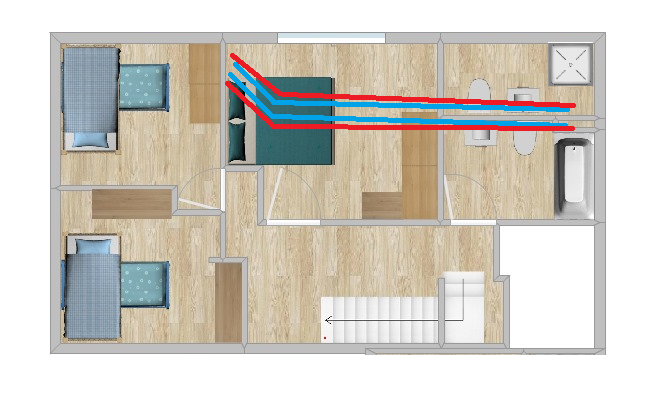
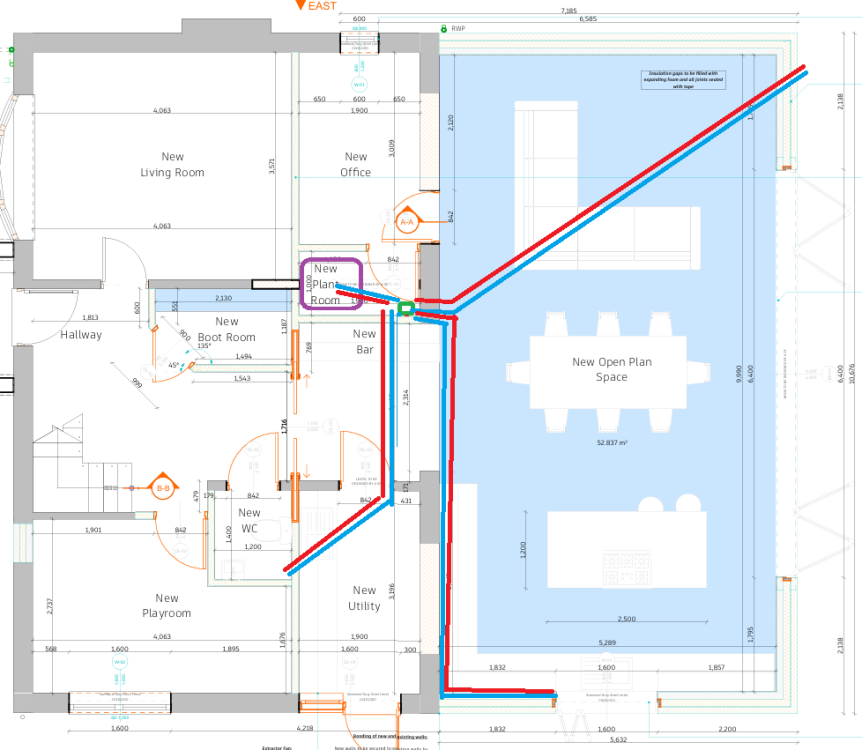
Sorry for the delayed response, ill kids thanks @JohnMo & @Nickfromwales Here are some sketches. I do not have a proper floor plan for first floor unfortunately. I plan to feed my new cold water main (green square) into the plant room which is located at the centre of the ground floor, my house will be 10m wide x 11m deep on ground floor, and 10m wide x 6m deep on 1st floor. There is no plan to put in a hot circuit. The plant room will also house my hot water cylinder, the purple square. The approx run lengths, including verticals, to these rooms are as follows; Kitchen: 12m Kitchen sink, dishwasher, fridge, outdoor taps (h&c) Outside rear wall: 12m outdoor taps (h&c), shower, future hottub. Downstairs WC: 8m Basin tap, toilet, future shower Utility room: 8m Washing machine directly behind WC. Family bathroom: 8m Basin tap, toilet, bath, shower En-suite: 8m Basin tap, toilet, shower Happy to consider individual pipes if a secondary manifold method is the wrong way to go. But it then takes me to 28 feeds + 1 for cylinder all within the plant room and approx 300m of pipe.
-
Hi all, I saw some really nice ideas on using manifolds from the cold feed and from the dhw to distribute through the house. I have a few specific questions related to my plan I hope you all can help guide me on. My project is a full house refurb and extension. I'll have 3 bathrooms, 1 kitchen, 1 washing machine connection (at the back of a bathroom), and hot and cold to taps outside. My current thought is to do this; Hep20 fittings and pipes New 25mm MDPE to plant room > 22mm stop cock > water meter > 4x (each bathroom & to cylinders) 22mm manifold ports + 2x (kitchen & outside) 15mm manifold ports > at each location secondary manifold to feed each appliance/fitting with 15mm The above would then be repeated to supply hot water but 1 less 22mm manifold ports as I can exclude the cylinder. Questions; 1) is it ok to go from a manifold to another? 2) should I use 15 or 22mm to go from the manifold to the secondary manifold? 3) Should I use 10 or 15mm to go from secondary manifold to appliance/fitting? 4) Is there a better brand to use for this type of system? I am using hep20. 4) does the order of the manifold matter? 5) any other tips? 6) is the general layout of my idea ok? Any suggestions? I really hope I haven't misunderstood all this manifold stuff! Thanks in advance
-
Thanks guys, attached the PDF of the floorplan here. Heating has been considered as I have a heatpump going in, the engineer has done a full heat loss calc 1.pdf No the SE hasn't suggested supporting the beam, he was confident with the rectangle box beam though.
-
The structural engineer provided this as the alternate UB 356x171x67. The RHS weighs 500kg, where as the UB will be 600kg, making things significantly more challenging logistically. I really do appreciate the complexities created by such a large opening, infact my wife wanted 7.2m initially!! I've talked her down to 6.4m so far.. Is there a reason for 5m specifically and do all these issues drastically reduce at this mark?
-
Hi all, My house has fairly recently plastered walls, there's no wall paper and not much damage to them. Other than the new stud walls to be created, I am happy with the state of the walls which will be left. There is going to be a first fix of electrics and plumbing so there will be damage/patch work. Some walls will have panelling added to it. I am planning on how these walls will need to be prepped as I could get this out the way fairly early. Right now my thought is to get an orbital sander and smooth off the paint that is currently on, affix panelling where needed, and then paint a regular coat with a roller or airless sprayer. thanks in advance!
-
25mm deflection includes calculations to bulk up the figure for safety. The opening is not build yet. I've asked him to provide an alternative calc for a UB. Hopefully something reasonable
-
This is the reason the structural engineer chose RHS For such a long beam on the inner skin we would not recommend using a UB section, as they are prone to twisting and torsion, and would likely need a really large section size to overcome that, which probably wouldnt look great. RHS beams are not prone to torsion due to their shape. Should I still pursue a UB?
-
Thanks, I can see their thoughts on adding a plate Not sure why they have suggested an RHS over RSJ, with the multiple opinions here about the two I will ask them to check which one is more suited for for my purpose. Yes flat roof joists will be mounted on this - using posijoists. thanks for the other info too
-
That @nod and @Conor, in my calcs he did say a shelf plate is optional. I have asked him to include this. Am I summonsed to use the same thickness as the RHS or just go thicker?
-
What would be the better alternate type?
-
Thanks John, I have queried this with him but wanted external thoughts too
-
Received my structural calcs today and I'm not so sure of the solution provided by the structural engineer. I have an extension going up which is 10m wide x 5.5m deep with a flat roof, and a bifold of 6.4m on the rear wall. The engineer has specified a length of 6.84m 250 x 150 x 8 RHS but it shows a deflection of 25mm which I'm concerned about as I need to minimise this for the bifold. Any suggestions on improvements? I have already suggested to make the steel longer as I'll be charged for 7.5m either way and the wall has plenty of space. thanks
-
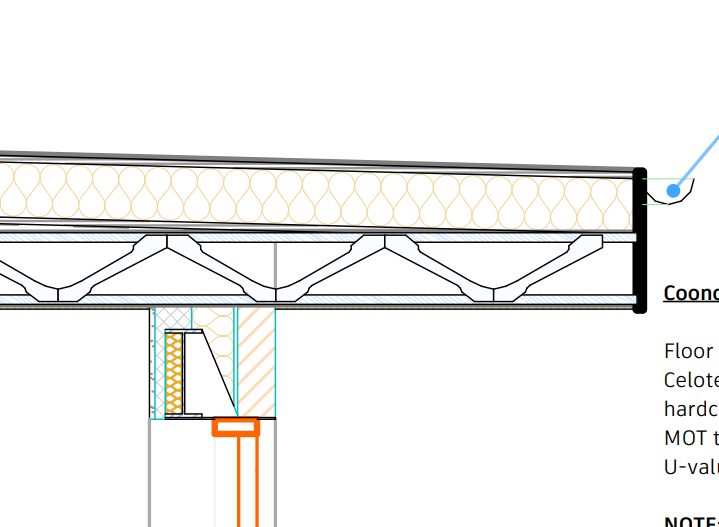
My project is in planning stages so hoping to get some advice to change my plans as I think there are big flaws. Hoping for a simple solution that I have overlooked!! The project is a rear extension width of house and out by 5.5m, plus an additional 1m overhang/canopy. I plan to use a warm roof and my builder has suggested to go with a posijoist system partly due to the span. The detail image below is from my architects plans. The way I see it, there is no "tucking in" and a huge cold bridge as the soffit of the overhang is pretty much directly connected to the "warm roof" space of the room. Ontop of that, the metal of the Posijoist will also be a thermal bridge even if this were insulated. I am struggling to picture where and how this should be insulated or if there is a better option. Thanks in advance, happy to provide more info
-
I read that people use EPS as a sacrificial layer and they expect it to be damaged. From my understanding the PIR would loose some efficiency if the foil were damaged. I will keep this in mind though as when it comes to actually do the work I may want to stop digging early or may get my levels wrong!
-
brilliant advice everyone! thanks for quickly reasoning me out of a potentially pointless approach. Having re-thought it briefly my rear garden slopes downwards and it may be a perfect opportunity to make use of my excavated material and to raise it all to being level (with a fall). @LiamJones Thank you for the calcs to give perspective. Any chance you can provide me a contact for grab hire? I expected to pay at the £300~ range. @JohnMo the Laminon grid layer is something I had saw on Youtube and I liked it as it lays flat avoiding any voids, it's under £100 for the whole floor so not breaking the bank if it's a helpful product. I did have a google for a Polythene sheet but would this be a vapour control or DMP version? Thank you for the tip on buying from a quarry, I have a few in a 15mile radius so will work with them I would 100% get loose as I have the space for it I really hope I can build up the floor in the way I plan.. It's going to be a big effort digging down 600mm!! a total volume of 39m3
-
I had some advice from a builder that if I were to raise the floor heigh internally then the existing DPC wouldn't work and I'll eventually get damp rising internally. He suggested to go ahead with ripping out the concrete and rebuild the floor
-
I am planning on digging out a 60m2 concrete floor, removing the current concrete floor and then building back up to do insulated UFH. Currently the floor is a standard build from 1970s so a concrete base. My proposed build up is; 15mm LVT planks 70mm liquid screen with UFH Laminon Underfloor Heating Grid 150mm PIR 100mm EPS DPM 25mm sand 100mm concrete 150mm Crushed concrete or MOT type 1 compacted Can I use Crushed concrete in MOT type 1's place? will a hire crusher work for this purpose? Thanks