MariaD
-
Posts
46 -
Joined
-
Last visited
Everything posted by MariaD
-
Thanks for the reply. the site is about 800sqm, my main concern is to find a possible water pipe underneath the ground so that I can build at 3m away from that. The site is on a small slope, so I also would like a topographic map to use for planning applications. At the moment I do not have an engineer, therefore if you could point out, in the case you are aware of, all the needed documents that an engineer would ask land surveyors, so that I can ask them. I think I will go with the digital version. Is that more expensive than the paper one?
-
Hi all, I'm looking for recommendations for land surveyors in the Waterford City area. I need it for a site survey, for the final purpose of building a house. I'd appreciate it if you could recommend/vouch for someone from your experience. Thanks for any help you can provide.
-
Certificates needed for site clearance
MariaD replied to MariaD's topic in New House & Self Build Design
Hi, thanks for replying. Could you please explain to me what CIL is? -
Certificates needed for site clearance
MariaD replied to MariaD's topic in New House & Self Build Design
Thanks for the answer. No, the asphalt patch is not part of a bigger scheme. Once removed, I want just grass growing. How do I check that he is licensed? -
Hi everyone, I've contacted a guy who would do the site clearance for my site. He asked me if I was looking for certificates. What will be removed from the site are the following: Weeds Overgrown bushes (Gorse) Some rubbish Dirt A small asphalt patch. Which of these require certificates? Who can request them, and what’s the cost? Additionally, do I need planning permission to remove the asphalt patch (approximately 40-50 sqm)? Thank you so much for your attention.
-
Polished concrete floor labour costs are a joke.
MariaD replied to flanagaj's topic in General Self Build & DIY Discussion
How much would it cost if you had already the slab and just wanted to have it polished at the lowest level of gloss ? -
I don’t plan to install any insulation since it’s the upper floor, and thus, the heat would still remain in the house.
-
Is it necessary to pour a concrete screed over a precast floor made of hollowcore slabs? Can porcelain tiles be installed directly on the hollowcore slabs without the need for a concrete screed?
-
ICF-Field-Test-Report.pdf (bchousing.org) According to the tests documented in the above link, it would be better not to but windows buck for better air and water impermeability. Did any of you used or not used windows bucks for your own house?
-
As per the title, I’m seeking advice on which blocks would be the strongest and thinnest for a partition wall in order to save money. I have a few questions that I hope can be answered: 1- I understand that a higher N value means a higher load-bearing capacity. But does a higher N/mm² translate into a more durable block? 2- If a standard block and an AAC block have the same kN value, do they have the same durability and load-bearing capacity when it comes to hanging cabinets? 3- Regarding sound insulation, do AAC blocks have the same insulation properties when compared to standard blocks with similar kN values? What is the thinnest block I could use for partition walls that has good sound insulation and is strong enough to hang cabinets on it? I found this one: Thermalite Aircrete Shield - Forterra. The thinnest size is 50mm and it has a value of 3.6N/mm² I'm looking for a good compromise between price, being thin, possibly lightweight and moisture resistant and if possible with the higher N values (7N and upward)
-
Thank you for the comprehensive explanation. Frankly, the expense appears to be a bit daunting. I hadn’t anticipated such a high cost. I also had the intention of utilizing the balcony to provide cover for the patio area and to offer shade during the summer. It appeared to be the most effective solution to me, but the expenses seem to be prohibitive
-
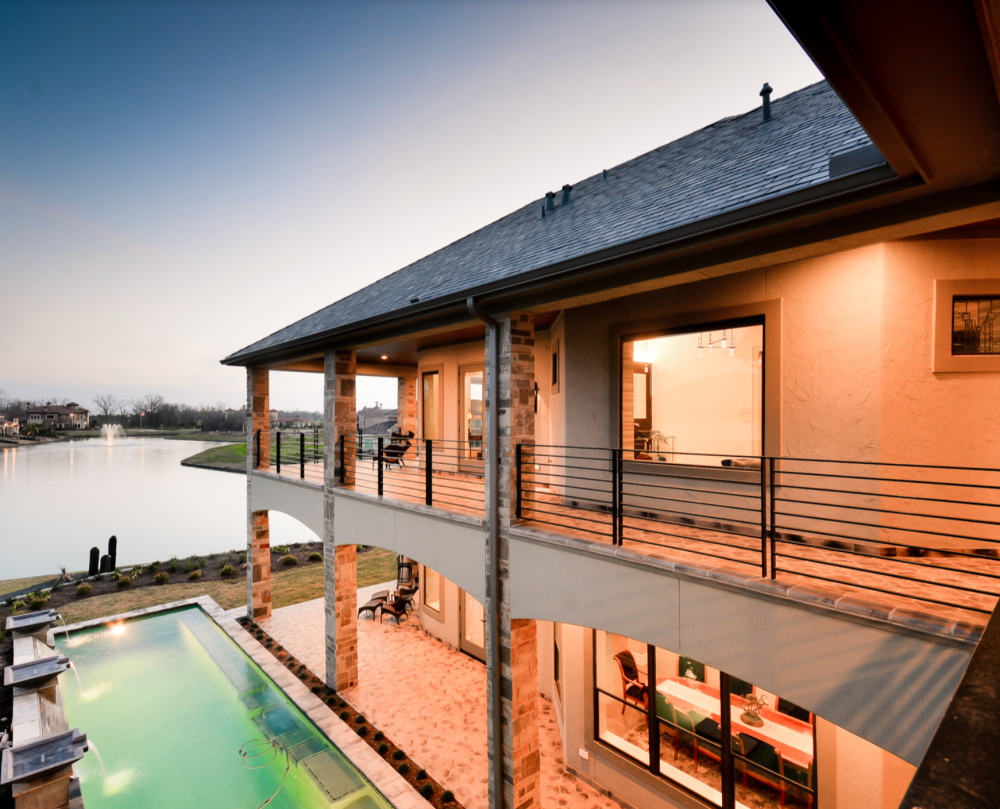
I have a rectangular house design, measuring 10.9m x 7.3m externally (10.3m x 6.7m internally), with the ridge of the roof running parallel to the longest side. The building is a two-storey structure, plus an attic. My question is this: Keeping in mind that the frame will be built using Insulated Concrete Forms (ICF), would it be possible to add a balcony similar to the one in the picture below (with the roof extended to cover the balcony) ? The balcony would be approximately 1.8m deep and 10.9m long, running the entire length of the house. What would be the best method to construct the balcony? If you were to estimate, how much additional cost would the balcony incur? Please consider that adding the balcony would likely increase the size of both the roof and the foundation.
-
Hi, I'm looking at options for internal partition walls. Does anybody have an idea about the costs per sqm (even with a large approx) of blocks vs stud walls when it comes to partition walls? Ideally I'd like to have the partition walls to be as thin as possible to have more space. For blocks I'd use 65mm thin blocks and I'd be considering painting directly onto them to save money. External walls will be built using ICF, how that would affect my choice?
-
Hi, I've bought a sie and planning to build my future house. I'd like to know if any of you can share the spreadsheet you have used to track the progress and the costs from applying to planning to turn-key. I've downloaded already different ones from the web, but I'd like to see other spreadsheets to create another one that would suit my needs and would be complete. Thank you in advance
-
ICF vs Precast Insulated Panels
MariaD replied to MariaD's topic in Insulated Concrete Formwork (ICF)
Thanks a lot for the valuable information you shared. It's particularly helpful to know that internal works and second fixes account for approximately two-thirds of the project. Could you share your preference for timber over SIP? SIP was one of the alternatives I was considering, but I'm facing challenges in finding a manufacturer that produces SIP with OSB4 panels. Did you have any issues with ICF after the house was built? Does it require any maintenance? Anyway, I'm going with a design as simple as possible. -
ICF vs Precast Insulated Panels
MariaD replied to MariaD's topic in Insulated Concrete Formwork (ICF)
Can you please expand on that? What was the reason for that (i.e. supplier went out of business?) -
ICF vs Precast Insulated Panels
MariaD replied to MariaD's topic in Insulated Concrete Formwork (ICF)
Thank you very much; the considerations you provided are highly valuable. The reason I am inclined towards precast panel walls, as explained in the previous post, is because it appears to meet all my requirements: durability, low maintenance, construction speed, noise reduction, and simplicity. Additionally, I neglected to mention that I am aiming to achieve, or at least come close to, a passive standard for the house. While I may not seek actual certification, I aspire to attain similar performance levels. Concrete's superior heat absorption is another advantageous factor. As for planning permission, I have not obtained it yet. However, the land I purchased is located in a residential-zoned area surrounded by other two-story houses. The envisioned height for the house I am currently designing will not exceed 9.2m, staying within the range of the neighboring houses. I had a pre-planning session, and the individual I consulted with assured me that the height would not pose any issues. I'm not aiming to finalize all the details at this point, but I would like to have a clear understanding of my preferences and potential considerations. Given your apparent knowledge of concrete, what, in your opinion, would be the optimal method for constructing a concrete floor while minimizing both thickness and weight? -
ICF vs Precast Insulated Panels
MariaD replied to MariaD's topic in Insulated Concrete Formwork (ICF)
Thank you very much for your response. I am open to exploring all options in theory. My priorities, in order, are durability, low maintenance, construction speed, noise reduction, and simplicity. While I understand that a timber-built house has the potential to last for centuries, my concern lies in the perceived higher maintenance requirements. Additionally, timber frames may perform less effectively in noise insulation. During storms, there might be vibrations in a timber-framed house, especially if opting for a timber floor, which is known to be noisier. In comparing masonry to methods like ICF or precast insulated panels, I assumed that masonry would take more time to build, considering the scarcity of labor in the sector. Another consideration is that ICF is simpler to construct and provides complete airtightness, while precast panels are manufactured in a factory. Consequently, these two options seem less risky to me, although I acknowledge that my perception might be inaccurate. If I were to contemplate masonry, I'd likely explore a single-leaf method using aerated concrete blocks. However, I've encountered criticism regarding these blocks being 'brittle' and prone to damage when exposed to humidity. SIP, while an option, presents similar disadvantages to timber frames. I want to clarify that cost is indeed a factor, but I would prefer to invest in the best building method that aligns with all my requirements, even if it comes at a higher cost than other alternatives -
Hello everyone, I find myself in a dilemma between choosing ICF or Precast Insulated Panels for the construction of my new house, specifically for external walls and floors. While I lean towards precast insulated panels, some questions remain unanswered. I plan to build a 2-storey house with internal dimensions of 8.5m x 8.5m, intending to make the attic 'habitable' with a spare room and utility space. I'm also considering raising the walls by 0.5m, essentially making it nearly a 2.5-storey structure. Additionally, I am contemplating a roof pitch of either 8/12 or 7/12. Here are my questions: Can anyone provide an estimate of the potential differences in cost and completion time between ICF and precast insulated walls? For the external rendering of precast insulated walls, is it sufficient to paint the concrete, or is another type of rendering (such as stucco) necessary? If rendering is necessary, what would you recommend for optimal durability and maintenance? Should a membrane be installed between the concrete and rendering to prevent trapping humidity/water? Concerning precast insulated walls, is rendering needed on the interior side, or is it possible to paint the concrete directly? Regarding the floor, if I opt for hollow core slabs, are load-bearing walls necessary on the ground floor, considering a span of 8.5m from wall to wall? How thick would the floor be approximately? I appreciate any insights or advice you can offer. Thank you.