


phykell
-
Posts
96 -
Joined
-
Last visited
Everything posted by phykell
-
 I don't know if this helps, but I'm intending to use integrated or "in-roof" solar panels which form the roof, i.e. instead of slates rather than the panels being positioned over them. Whilst my application was ultimately refused, the section discussing the solar panels seemed to be acceptable: The wording isn't exactly idea but it I believe they're saying that the integrated solar panels are part of the material of the building, so if you're replacing the roof, it might be worth arguing that your simply retiling at least some of the roof in solar panel/tiles.
 -
I recall another reasonable quotation I had from kingdomecology.com - I would have gone with them had I not previously used WKS for my project. I think they operate in NW England.
-
The first report I had done said an emergence study wasn't required but that report expired and I was forced to have another one done. In that report, the ecologist said there was a very low risk of bats but that the building had places where bats *could* roost. I fixed the "holes" and slipped tiles and the LPA wasn't interested. I imagine I would have needed a repeat report because the LPA doesn't trust the householder but it the price difference wasn't worth the hassle. I might have been able to force the issue but I was more interested in saving time, hoping to get the thing demolished so that I could get on with the rebuild. I don't have a planning consultant - I just wanted to demolish an old, falling-down garage. All done now though.
-
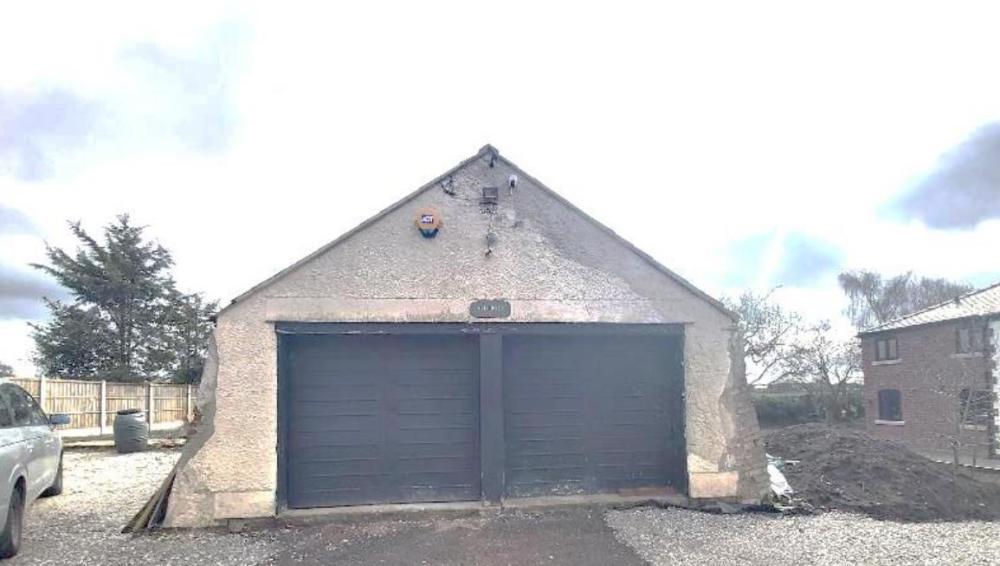
I tried that as well but the LPA insisted that the emergence survey was still required - I would have "fought" it but it had already been dragging on for ages. I asked the guy who did the preliminary assessment to indicate where he thought the bats would potentially roost - he supplied photographs with the areas marked and I subsequently sealed them all but this still wasn't enough for the LPA. And this was all despite the fact that, just over a year previously, I'd had a bat survey done which *didn't* require a emergence report! Of course, I couldn't rely on this previous report because, apparently, they "expire" after a year. To provide some context, all I wanted to do was demolish an old run-down garage (image attached) and they made me jump through all of the hoops possible, causing me unwarranted delay and expense when anyone with any sense would take one look at the building and just agree to its demolition (even for safety's sake as the buttresses were collapsing) - it's all a *massive* con. You don't need planning permission to demolish an outbuilding, even in a conservation area, if the volume is less than 115m3 but mine was arguably just under 120m3 - unfortunately, this made no difference so I learned not to expect any reasonable compromise from an LPA, ever.
-
My quote (prior to the demolition of a single storey, double garage) was £522 + VAT for the following:
-
Hi, I'm having an garage/outbuilding constructed at the front of my house (principal elevation is to the rear) and while I've employed two architects over the last few years, neither of them have produced an accurate survey of the plot, preferring instead to use existing documents showing the plot in a reasonable level of detail. However, it's not necessarily accurate at all - my front garden is a really odd shape and I suspect the boundary between myself and my neighbour has been somewhat "flexible" - he had the original fence rebuilt and it may have ended up running over some of my land. I'm not really bothered about the boundary being overrun but my outbuilding has to be 2m away from it and I now want to have an accurate survey done of my plot. Any suggestions how to tackle this and is it possible to do it myself?
-
To think, I started this process back in January 2023... So I'm looking at a year for a decision from the point I appeal - seems like the councils have the odds stacked against the householder and the planning inspectorate aren't even approaching the performance targets they're supposed to be aiming for: New ministerial performance measures for the Planning Inspectorate - published January 2022: "moving progressively towards all cases across all appeal types being decided in these ranges: wholly written representations: 16-20 weeks" https://www.gov.uk/government/news/new-ministerial-performance-measures-for-the-planning-inspectorate
-
I hope it's not going to take that long as I've been living with my garage contents cluttering up my main lounge (we can't use it) and a driveway covered in hardcore/MOT with unsightly, temporary wooden gates. Perhaps mentioning all that would speed up the process - hope springs eternal, etc.
-
I think that I could have done more to do just that. I sent the case officer an email yesterday to ask for her consideration of the additional information I was able to provide based on the contents of the refusal. As I say, because the documents end up in the public domain, I didn't think I needed (or wanted) to show/explain everything and I'm unaware of any specific rules regarding the information that the LPA can and cannot (or should not) request. Unfortunately, if an applicant arguably doesn't provide enough information, the LPA can and does take advantage of this grey area and isn't compelled to warn the applicant that they're considering a refusal, which could be mitigated with more information, before they make their decision. I've provided a plan in my email with images of the contents of the proposed garage as, for example, the refusal cited the size of an average family car and how the garage was larger than necessary. As it turns out, we have two estate cars which are longer than the average car and the other items quickly fill the available space. Another thing I missed (only thought about this last night) was the length of the pool - I wanted to stick to the size of the original pool but chose to use 11m as an ideal compromise based on what I read online, etc. I should have underlined the point that the pool length wasn't arbitrary. Luckily, I did remember to point out that the plant room size was suggested by the pool company I'm using (and online sources concur). I'm convinced I'll have to go to appeal and, from my experience appealing another decision about a balcony, I believe the process will allow me to offer supplementary information that wasn't originally provided to the LPA rather than simply arguing the case based on what they originally had. I hope I'm right about that.
-
Exactly - we have loads we want to do with the space, just as you're doing, including growing our own vegetables which is a huge undertaking on its own. In the current climate as well, people are spending more time at home, pursuing hobbies/interests, etc. - a good thing
-
It is indeed just down to the incidental enjoyment, etc. and it even seems that they're happy with all of the reasons I've specified. The problem is the amount of space, and of course, I don't agree. They've even suggested that I should have discussed the shed I have, I guess as a potential location for the lawn tractor and other gardening equipment - needless to say, my mechanical equipment will fare better in an insulated brick building and I feel like it's a bit over the top having to justify absolutely everything such as, for example, intending to use the shed for cutting wood for the log burners, woodworking, potting and general gardening - we have a very large garden so I need a lot of equipment
-
Sadly, that doesn't apply as they've only just refused it. It's crazy how their rules seem to change so arbitrarily.
-
No, I don't think so. I've re-read the refusal document several times and I think it all comes down to this: Although, when broken down, none of the proposed uses of the building appear obviously unreasonable (even though in scale all are more than generous), the activities indicated in the application, in the main fall into categories that, individually, may be acceptable as incidental to the enjoyment of the dwelling house, however taken together they occupy an unreasonable amount of space. It has not been demonstrated that the outbuilding is genuinely subordinate and reasonably required for purposes incidental to the enjoyment of the dwellinghouse. Thus as a matter of fact and degree the proposals do not come within the terms of Class E of Part 1 of GPDO. So, they seem to agree that all of the purposes I've outlined are reasonable (or "not obviously unreasonable" as they prefer to say) but that taken together, they occupy an "unreasonable amount of space". I've worked on the internal layout and I wish it had been submitted as it now is because I'm genuinely having to squeeze everything in rather than it being "generous". But, I didn't want to go into vast detail on the building's intended contents as it's then in the public domain.
-
I've already started writing my "Refusal Mitigation" document 😎 As I'm re-reading it again, I can't help but wonder at why my garden shed and its double doors was brought into it, as though that should impact the outbuilding size - I can't park any cars in the shed and the lawn tractor takes up 75% of the length with its trailer. Then there's the lawn spreader, log splitter, it goes on. Time I just bought a bungalow somewhere. 😅
-
I certainly hope so based on those figures 😎
-
The mind boggles - why would they refuse it if they believe it would win an appeal? It's just wasting time, effort and money and it's acting against the spirit of PD.
-
Yes, but now they have a framework for enforcement if I was to proceed. I'm sure they're wrong - I just can't believe that both the case officer and her manager signed it off. I guess that's the issue with delegated reports.
-
I did just speak to the planning inspectorate to ask their advice before going to appeal and they said much the same - that I could at least contact the case officer to see if any amendments or further explanation would help so I'm looking at that now.
-
Thanks - I'm going ahead with the balcony appeal and you're right, it does look OK but the reason for refusing the LDC is more complicated. I've met all the PD requirements - this one they're leveraging against me is something else entirely. As part of their justification, they've stated that they don't know how many people are resident (they know there's just two of us) as though that should have any bearing and they even go on to say that we've omitted details about the large shed we have in our garden (which is full to ther rafters of gardening and woodworking stuff already). They even ignored that I mentioned the garage would house my lawn tractor (with its trailer, it's longer than many cars!). They then go on to complain about the sun lounge area of the pool (the pool cover will be underneath that area along with pipework) as being something we could have in the main dwelling. My architect who managed the application, asked them if they needed any other information but they didn't bother and then they went five weeks after the decision date - it's been over three months. I'll get the balcony appeal done first so I can see what the process is but I'm already stuck on the three options it offers regarding the complexity of the planning - any idea what's best there? Do I go for the "complex" one? [Edit] I think it has to be "Written representations". The planning portal also recommends getting in touch with the planners and that appeals should be the last resort - is that worth it? It'd be great if I could clarify any points with them that they didn't ask me about in the first place
-
Hi, I applied for an LDC last year - it's taken until now for the LPA to get back to me with a refusal, stated as follows: Based on the available evidence, the LPA is not satisfied as a matter of fact and degree that the proposed building would be genuinely subordinate and reasonably required for purposes incidental to the enjoyment of the dwellinghouse. Accordingly, as a matter of fact and degree the proposals do not come within the terms of Class E of Part 1 of GPDO. The background is that I wanted to replace and resite my dilapidated two-bay garage with a three-bay garage but it was refused (I'd renovated the main dwelling and extended it 50%). I then said I'd use permitted development (turns out they had imposed limitations on my original plans which weren't correct but they never suggested the PD route either) and they advised me to seek an LDC which I did. I decided to create a three-bay garage and extend the outbuilding, as a whole, over an adjacent, disused swimming pool - nothing out of the ordinary, as both uses are within the the planning-specific principle of incidental use rather than ancillary use. My proposed outbuilding satisfies the usual PD requirements such as the maximum height, area within 50% curtilage, distance from boundaries, eaves height, etc. - they admitted all of this in the case officer's report but the LPA has essentially said (above) that my outbuilding will be too "big" (that's my summary) for what I want to do with it. To my mind, they're grasping at straws, if not being vexatious, but what's my next move? I've asked to speak to my local councillor in the meantime but should I appeal myself or should I appoint a solicitor, planning consultant or other specialist? Please note that I'm already appealing their decision on a balcony to the main dwelling as well. Thanks
-
My mistake I think - having re-read the guidance: The sixth type of qualifying building is constructed when all of the following apply: 1. a garage is built, or a building is converted into a garage 2. the building is constructed or converted at the same time as, and intended to be occupied with a building ‘designed as a dwelling or number of dwellings’ ― read paragraph 14.2 I missed the "all of the following". It's definitely not being built at the same time as any buildings designed as a dwelling. Perhaps the incoming Labour government will lower the VAT rate, or, God forbid, raise it!
-
Hi, I recently renovated my house and had an old two-bay garage demolished. I'm building a new three-bay garage in a different position to the original but I'm considering extending it so that it covers an old, disused swimming pool with the aim of potentially renovating the pool and adding a gym, shower, sauna, etc. I note that the following guidance on VAT implies that a garage can be zero-rated for VAT: https://www.gov.uk/guidance/buildings-and-construction-vat-notice-708#para3-2-1 However, in the same document, it mentions that enclosed pools can't be zero rated - it does seem odd that two examples of incidental use, i.e. not ancillary, can have different VAT rules. It might sound complicated but I wondered if I can have the garage built, extend it as an enclosed pool/gym and claim (say) one-third (for the garage bit) of the VAT back - does that sound reasonable? Thanks
-
In my experience (in a conservation area and greenbelt), you can't assume the right to have 50%, it's more likely to be "up to" 50%. You can even go larger but you'd have to convince the local planning authority that it was in keeping with the original development. I was able to build up to 48% of my original dwelling: a two-storey side extension and a single storey extension to the rear but it required full planning permission with a huge amount of effort from myself and my architect to have it all approved - it took years to do it and I'm still not finished! With regards to permitted development, I would immediately seek confirmation from your LPA that an article 4 doesn't apply as DevilDamo mentions. From experience, it's worth getting this in writing if at all possible. Also make sure that your "principal elevation" is identified - it's probably fine but many older houses were built with the PE to the south for the sake of maximising sunlight into the front of the house or were built side-on to an original road/track whereas more modern houses have their front to the road. I had to argue my case for PD that the original dwelling's front was now the rear of the property so that I could build my outbuilding in the most appropriate location. Again from experience, if you want an outbuilding and article 4 doesn't apply, PD should apply with some caveats such as limiting you to build to the rear (i.e. not the sides) of the main building. Also consider applying for a "lawful development certificate" from your LPA. Note that this may take as long as a full planning application - I'm currently trying to have my own outbuilding approved for lawful development via PD after my original planning application was refused - I'm optimistic I'll get it but even though my planned outbuilding conforms to all of the obvious constraints such as overall height, eaves height, distance from boundaries, etc. the council have cited case law regarding the size of the structure in terms of whether it's reasonable and falls within the definitions of being incidental (as opposed to ancillary) to the enjoyment of the main house, i.e. you can't just have a massive outbuilding with no reasonable incidental use planned for it. There are lots of relevant resources on YouTube but one of the better ones is this guy: https://www.youtube.com/@efkor/videos
-
LDC for a Garage - Planning Portal question has me stumped
phykell replied to phykell's topic in Planning Permission
Sorry I missed the replies but yes, I was just within the time frame and I completely agree about the ever-increasing charges. The application was validated on the 19th December last year and I'm still waiting for a decision, even though the determination deadline was the 13th February (the council didn't request an extension). I have to keep reminding myself that it's only for lawful development certification rather than full planning - no neighbours need to be consulted, no surveys to read, no external consultants required, etc. but wait... The latest information I have is that the council are consulting their legal team over whether they're satisfied that the outbuilding is “incidental” to the enjoyment of the main dwelling, citing 1989 case law [Emin v Secretary of State for the Environment and Mid-Sussex District Council (1989)]. Probably worthy of a separate thread but here's a relevant quote: The Court has acknowledged that the fact that such a building “has to be required for a purpose associated with the enjoyment of a dwelling house cannot rest solely on the unrestrained whim of him who dwells there but connotes some sense of reasonableness in all the circumstances of the particular case”. The outbuilding will consist of a three-bay garage and poolhouse which will also include a shower, pool plant room and an area for the solar PV system's equipment, batteries, etc. All of these items are of course "incidental" rather than ancillary and the shower (arguably ancillary) is subservient to the pool. -
Misery really loves company. I had to have an ecology survey including bats, newts, etc. together with an aboricultural (tree) survey for my house renovation together with an archaeological report penned by an archaeologist who was on-site whilst all of the foundations were dug - the same archaeologist also did a full report on the structure/design of the house as it was to be added to the heritage asset list - it was built in the 1750s and the conservation area it's in was mentioned in the Domesday book - the land dates back to the Romans as well so I didn't mind the archaeological report to be fair but the total cost of all of the surveys was quite something. OK, so around a year later, I then wanted to demolish a dilapidated garage and replace it with a much larger outbuilding. Despite the fact I had all of the surveys from just over 12 months before, the council demanded that I redo the ecological and the arboricultural ones (no archaelogical survey required, luckily), despite the fact that the earlier reports had found no bats, newts, etc. and the old garage/new outbuilding, were nowhere near any trees. I asked if the previous reports could be "updated" but was told that wasn't an option. The ecologist visited and decided that while he found no evidence of bats, that the old garage, before it was to be demolished, needed to have a bat survey done as there were places where they could easily access the garage, though that would only happen in roosting season. I was told to have another survey to check if bats were using the garage to roost but I'd have to wait as it wasn't the right time of year, delaying me by several months. However, I then repaired the roof/eaves of the garage to be demolished so that if bats did turn up to roost, they wouldn't be able to, obviating the need to conduct a roosting survey (so I thought) - however, I was told that wasn't an option either! Fast forward to roosting season, two people turned up, sat in their car watching for bats to enter/exit the (now fixed) garage roof and eaves, walked around the property a couple of times and left after a couple of hours. Despite it only requiring a tick box to say "Bats present - NO", the report was delayed and took over a month to complete. Money for old rope indeed.




