mattman
-
Posts
30 -
Joined
-
Last visited
Everything posted by mattman
-

Self-build steel frame barn conversion - almost complete
mattman replied to mattman's topic in Introduce Yourself
It used to be an agricultural steel shed. What kinds of air tightness scores are people getting on a masonry build? -
Self-build steel frame barn conversion - almost complete
mattman replied to mattman's topic in Introduce Yourself
Thanks for your reply. Here's a pic from a few weeks ago. It's still a bit of a mess.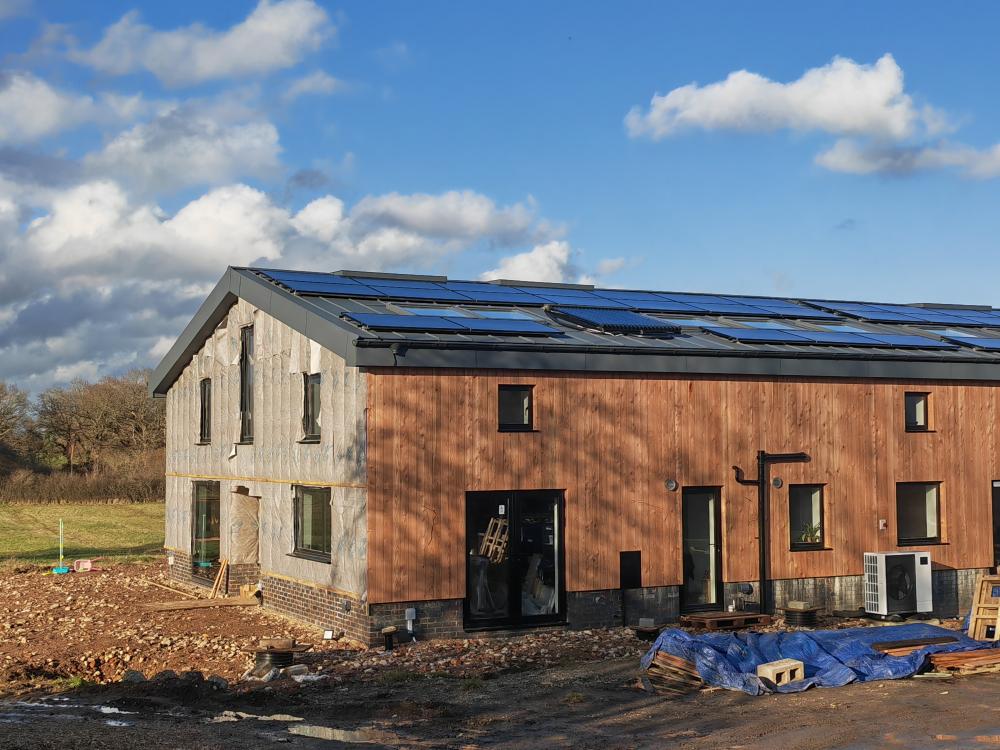
-
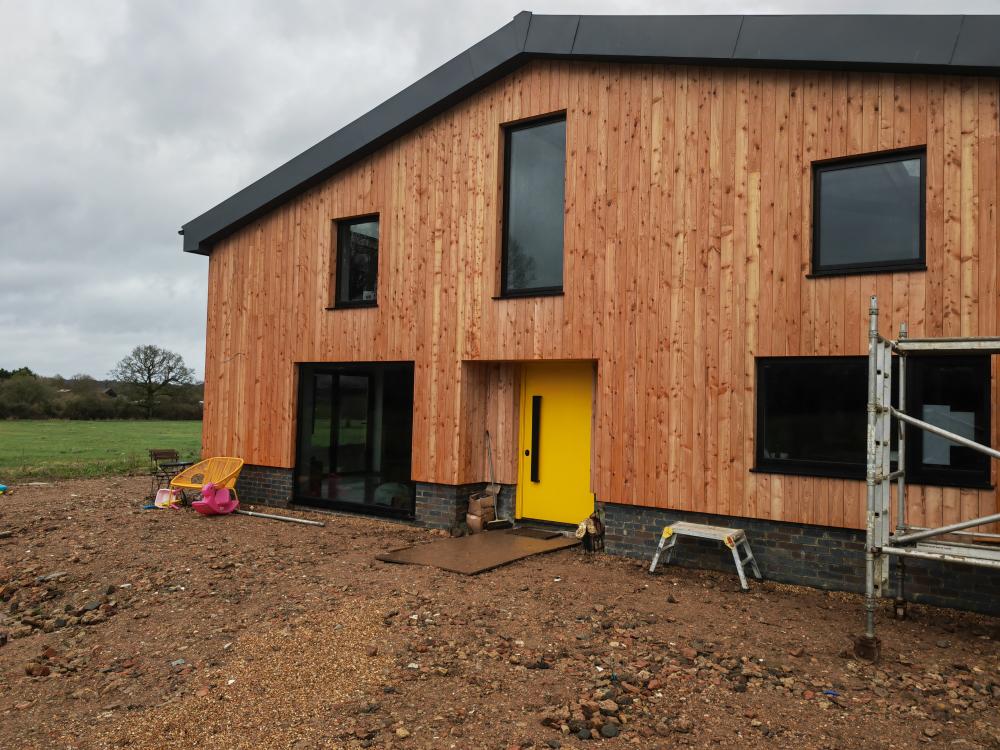
Hi everyone I just wanted to introduce myself. My family and I are just coming to the end of a self-build steel framed barn conversion which started back in 2019. We only have minor things left to do. I project managed and also designed the entire house and my wife and I did all the planning application. I'm not an architect - it was more the fact we were left in the lurch by a really poor planning consultant/architect that we decided to take over ourselves and pleased we did. Our house is fairly standard block and brick masonry cavity-wall construction and we have quite large 150mm block cavities (concrete blocks for the external skin and thermalites on internal skin) full-filled with 150mm breathable mineral wool insulation, plus a further 50mm waterproof mineral wool externally behind cladding (crucially still allowing plenty of ventilation behind cladding), 100mm PIR celotex in floor (would have done more in floor but we're limited by potentially low ceiling heights), 200mm PIR celotex warm roof with an airtight VCL. We had a builder build our foundations and shell and he also put up some plasterboard on internal walls, we have a full wet plaster on all external walls. We had a separate roofing company do our metal roof, a cladding company have done our larch cladding and electrician and plumber are close to finishing our second fix items. My wife and I took over from the builder after he left. I then spent many weeks applying a cement lime "parge" coat on the inner face of all external walls (prior to our plasterer doing the full wet plaster), and I applied air tight tape everywhere in an attempt to make the house as airtight as possible - it was hard because our builder did not see the importance of air tightness. I've also built an exposed brick wall spanning half the entire downstairs and we also fully prepared the entire groundfloor for our concrete pour - doing the insulation, membrane and steel mesh etc, as well as doing some of the insulation and VCL in the warm roof. We had a concrete company pour and powerfloat the concrete slab which acts as our finished floor surface, as well as being a good thermal mass. Our house is heated solely by an 8.5kW ASHP and costs very little to run, which does all our hot water and our space heating, via wet underfloor heating in our concrete slab on the ground floor (no heating upstairs aside from a couple of electric towel rails). We also have solar thermal tubes which isn't doing much at the moment with the cloudy rainy weather and we also have 7.6kW solar PV on our roof which will be connected to an inverter and batteries later in the year. We also have MVHR. We just had our air tightness test done and we scored 2.5 m³/hr.m² @50Pa for the standard air permeability air tightness test, and 1.96 ach/hr @50Pa under a passivehaus air tightness test (although I can't use the Passivehaus test result for my SAP calcs). Dealing with non-straight original timber roof perlins and other characteristics in the original barn, and being masonry construction meant getting it air tight was a challenge.. plus it was a bit of a battle dealing with most of the trades who did not understand the importance of air tightness - our main builder thought we would never be able to open our windows! And it was solely me doing any kind of air tightness work. I'm not sure if 2.5 for a masonry house is ok or not?? I had hoped it might be slightly better after all the time I spent but I'm glad it is lower than 3 though because we have an MVHR and these work better at 3 or below (and at the end of the day it is just a number). House appears to stay warm, costs virtually nothing to run, no mould or condensation thanks to the MVHR which also evenly distributes the warmer air downstairs to all rooms upstairs, so overall really happy. It's been a lot of extremely hard work, especially with three quite young daughters, and working full time. Sorry for the long introduction. Attached is a pic. Matt