S2D2
-
Posts
437 -
Joined
Everything posted by S2D2
-
Interesting idea at the moment but difficult to project far into the future I guess. It requires MCS too but at current rates might cover that additional cost. Thanks!
-
Yep increased fidelity will improve accuracy if anyone else wants to try this. It's always annoyed me that I can't easily ping the smart meter for a reading, the DCC data is often ~8 hours late so you can't do any real time control with it, but it's good enough for basic calculations like this.
-
This is one of a number of limitations of the abstracted model which I'm ignoring completely and crossing fingers that the summed effect isn't significant. The data is simply not available at a high enough fidelity to model such events. Another is averaging PV output data, which not insignificantly undermines the battery simulation accuracy as the battery has a min/max which causes clipping.
-
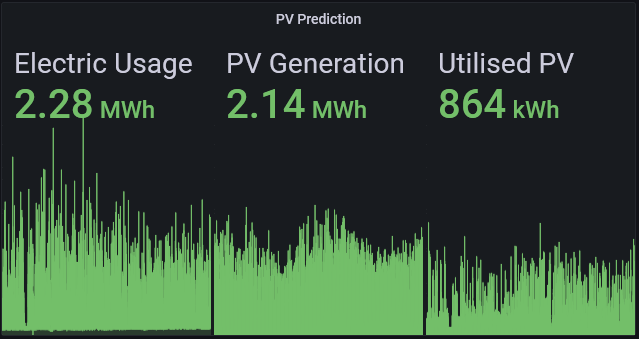
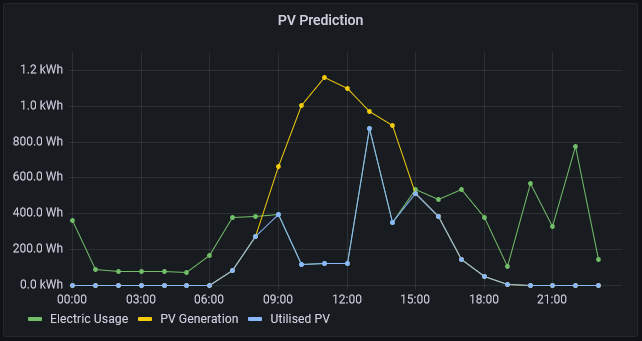
I've been interested in PV for a while but put off by the variance of estimated savings making it difficult to determine how useful it would be to my specific house. PVGIS is a fantastic tool, but how much of that generation could I actually use? "Around 50%" wasn't specific enough for me but fortunately, my smart meter was recently updated to connect to DCC, so it was time to go down that rabbit hole, results shared here to prompt debate and so others can point out errors and maybe explore a similar study on their own property. Firstly, hourly data for the proposed install location was downloaded from PVGIS and averaged over the 2005-2020 period available: https://re.jrc.ec.europa.eu/pvg_tools/en/. This average was then dumped into an InfluxDB database Next, half-hourly consumption data from my smart meter is available via a DCC connected company, with 13 months of data available. There are a number available, I chose Bright as they have API support: https://play.google.com/store/apps/details?id=uk.co.hildebrand.brightionic. This data was pulled down with a python library into the InfluxDB database: https://github.com/cybermaggedon/pyglowmarkt. Note I had to pull 10000 minutes at a time as there seems to be a limit on request size. Now I have all the data, there's a few options on what to do with it. Firstly, Grafana was used to support detailed interrogation of the data as well as an in-built method for summing timeseries data. Below pictures are for a 3kW system mounted vertically on a ~SSE facing house wall: Annual utilised PV is just the min of usage/generation for each hour in the time series. The result is... disappointing, suggesting if I'd had this system installed over the last year I'd only have used 40% of the generated power. As with most houses, the culprit is significant evening usage - computers, TVs, dishwasher etc. I can shift some of the usage to mid day, but not enough to make a significant enough impact. Inspecting a random day (6th September) confirms an increase in PV size would not solve the problem either: Area on this graph is kWh so it's easy to see a lot of wasted generation mid day (between the blue and orange lines) followed by significant grid usage in the evening (between the green and blue lines). Note that electicity consumption is quite low as my heating and hot water is from mains gas. Ideally this excess could be dumped into a hot water tank but we have a combi boiler and I'm struggling to make the sums add up once you factor in even more initial investment for a tank etc. Therefore I'm ignoring offsetting gas consumption and purely looking at the significantly more expensive unit rate electricity consumption. That aim then brings us to battery storage. I couldn't find a way to simulate state in Grafana so used the InfluxDB Python bindings to set up a basic charge/discharge simulation across the year. It does not factor in battery efficiency due to me being lazy which will slightly skew figures. This simulation takes three parameters: PV system power in kW, battery capacity in kWh and the unit electricity rate to calculate savings. Hard to predict for a long term investment so I just used the current 27.09p/kWh rate. It's then possible to experiment with proposed systems: $ ./battery_sim 0 0 0.2709 0.00kWh utilised and 0.00kWh stored out of 0.00kWh generated. Total 0.00kWh (0%). From grid: 2280.95kWh. Annual Saving £0.00 $ ./battery_sim 2 0 0.2709 750.32kWh utilised and 0.00kWh stored out of 1424.67kWh generated. Total 750.32kWh (53%). From grid: 1530.63kWh. Annual Saving £203.26 $ ./battery_sim 3 0 0.2709 863.03kWh utilised and 0.00kWh stored out of 2137.00kWh generated. Total 863.03kWh (40%). From grid: 1417.92kWh. Annual Saving £233.79 $ ./battery_sim 3 5 0.2709 863.03kWh utilised and 998.04kWh stored out of 2137.00kWh generated. Total 1861.07kWh (87%). From grid: 419.89kWh. Annual Saving £504.16 $ ./battery_sim 4 5 0.2709 930.05kWh utilised and 1102.64kWh stored out of 2849.34kWh generated. Total 2032.69kWh (71%). From grid: 248.26kWh. Annual Saving £550.66 $ ./battery_sim 4 9.5 0.2709 930.05kWh utilised and 1151.73kWh stored out of 2849.34kWh generated. Total 2081.78kWh (73%). From grid: 199.17kWh. Annual Saving £563.96 $ ./battery_sim 5 9.5 0.2709 970.84kWh utilised and 1211.10kWh stored out of 3561.67kWh generated. Total 2181.94kWh (61%). From grid: 99.01kWh. Annual Saving £591.09 $ ./battery_sim 5 13.5 0.2709 970.84kWh utilised and 1221.01kWh stored out of 3561.67kWh generated. Total 2191.85kWh (62%). From grid: 89.10kWh. Annual Saving £593.77 $ ./battery_sim 7 13.5 0.2709 1018.43kWh utilised and 1268.62kWh stored out of 4986.34kWh generated. Total 2287.04kWh (46%). From grid: 0.00kWh. Annual Saving £619.56 Quite easy to spot the return on investment of the PV and battery capacity is tightly coupled, no point having loads of generation you can't store or massive storage with no excess generation. This is where I've stopped for now, it'd be trivial to go one step further and optimise the system for most cost-effective setup but that would need a cost function for £/kW solar and £/kWh storage (installed) that I haven't bothered to put together yet. Note that the upgrade to a Tesla Powerwall (13.5kWh) is very cost-ineffective, but could technically provide 100% of my usage with a 7kW solar array. The 5kWh battery with 3kW PV seems a sweet spot for me and uses 87% of the generated power but I'm unsure on the costs of such a system yet. To go ahead I'd prefer a maximum 10 year ROI which sets pretty tight budgets, ~£2k for a 2kW system with no battery or ~£5k for a 3kW PV 5kWh battery system. This obviously rules out MCS, but has anyone got close to this with self installation and connection by an electrician? Comments and questions welcome, does this line up with actual performance people have seen from their installs?
-
As a follow up, I went with option 2, redistributing 50% of the flattened insulation into the other half of the loft and topping up the resultant gaps with new. Nothing to the tip or through the house which was a big win. Average insulation depth now 400mm and loads of storage up on the loft legs, which worked really well with P5 T&G chipboard sheets 2.4x0.6m. In case anyone else is doing something similar, I used a dustpan to scoop the old loose fill insulation and an old bread knife to cut the new rolled insulation, worked a treat. Fitted a couple of 1.5m batten LED lights before doing the job which made everything a lot easier, highly recommended.
-
Manthorpe G630 is what I used every other truss at the lowest overlaps. I have the bitumen type felt so the only ventilation was from the eaves and there were nowhere near enough soffit vents fitted to prevent condensation at the coldest point of the year. These vents just open up the overlap between the felt a little bit and seem to have done the trick, I pulled the felt open by hand before buying and a fair amount of airflow does come through. Thanks for the link @tonyshouse, I came across this when I was doing the subfloor and paid a lot of attention to foaming up appropriately when I had access to the beam and block floor. There's a great design feature in my house where the pipes run under the floating floor (chipboard on 50mm polystyrene) with big gaps either side of the pipework. Coupled with a few leaks in the beam and block floor this means airflow can traverse the entire downstairs central heating circuit. Whilst I had the kitchen floor up I switched out for PIR taped at seams and fitted pipe insulation, but this has only improved approx 25% of the floor area. The gaps the builders left in the polystyrene were absolutely ridiculous.
-
Thanks @vala, I noticed B&Q do a similar product now too. I can definitely see the advantage but unless I'm mistaken it's still about twice the price of fibreglass? If I was starting from scratch I'd be tempted but I'm at least keeping the 170mm top up so unfortunately the loft will remain an itchy torture chamber regardless.
-
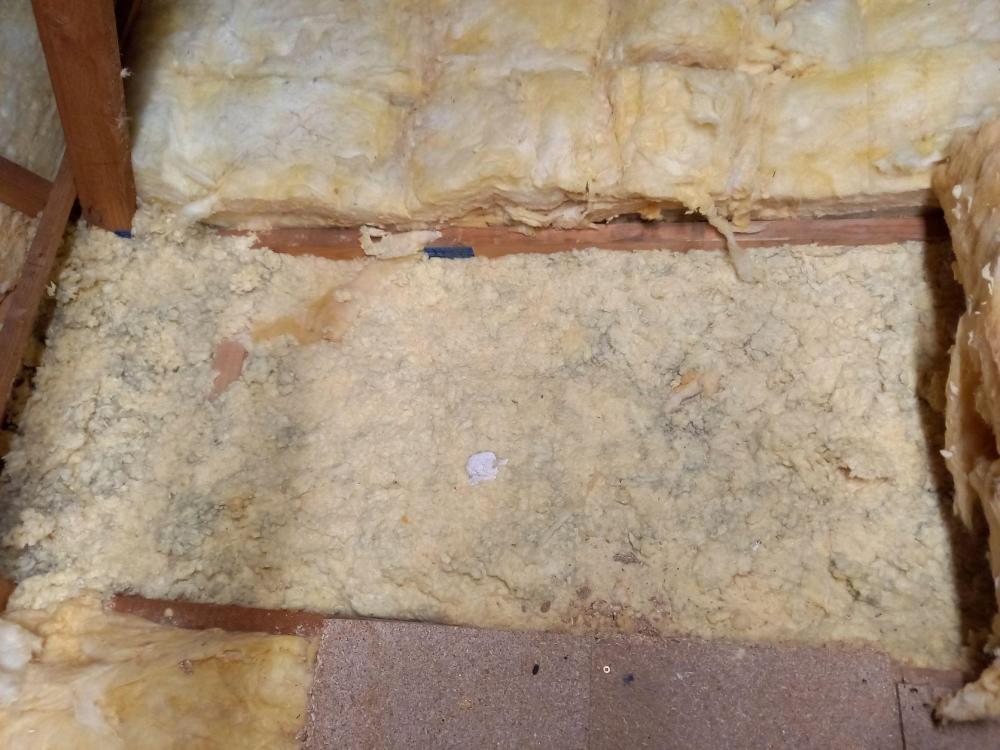
Thanks all, leaning towards option 1 or 2 to avoid having to remove any. Here's a picture for reference showing the state of the old stuff, the visible side of the joist should of course be hidden by nice fluffy insulation. Not sure on the insulative properties of kitchen roll, have the previous owner to thank for that. New stuff laid in the same direction in the middle section for ease by the energy company's fitters, I'll correct this to make it perpendicular. I'm also curious on the waxed paper!
-
Here's one that might cause a healthy debate, but I'm having trouble deciding so thought I'd offer it up to the experts. I'm about to board out our loft for light storage on XL Loft legs which leave a 300mm gap above the ceiling joists. The house was built in 1992, so the ceiling joists are only 70mm deep, giving a 370mm void for loft insulation. Currently we have two forms of loft insulation: the original loose fill fibreglass "filling" the 70mm joist depth and approx 170mm of newer (approx 8 years old) fibreglass insulation rolls installed before we moved in under one of the previous energy company schemes. The newer roll is generally in good condition, heavily compressed by the previous owner's loft boards in some places yet should be reusable. The debate I'm having is on whether to replace the loose fill fibreglass insulation which is now 30 years old with new fibreglass rolls. It is heavily compacted across the loft and probably has an average thickness now of ~30-40mm instead of the 70mm it should be filling which will obviously be impacting the R-value and allowing air currents between the two layers of insulation. My options as I see it are as follows: 1) Fluff it up as best as possible, get on with boarding the loft. Save a lot of faff and swearing in a low head height loft space. 2) Redistribute and fluff into half the area, fill the other half with new insulation. Old stuff presumably twice as dense after this, R-value reduced to..? 3) Get rid of all the loose fill and replace with new loft roll (100mm squashed slightly into 70mm, R-value reduced to..?). Sending it to landfill doesn't sit well with me but maybe freecycle could avoid that issue? After relaying the 170mm I'll add new 100mm roll which should give me 340mm insulation and a 30mm air gap below the chipboard, which I've heard some people recommend to avoid condensation issues under the chipboard. Our loft has had severe condensation issues in previous years but that appears to have been fixed by the addition of felt lap vents which have left it dry for a whole year now. To allay any concerns, I'm using a proper fitted/filtered mask, goggles and long clothing. Loose fill fibreglass is the devil when disturbed.
-
Hi @Marvin, thanks for the great response! By plasterboard tenting I mean we have dot and dab plasterboard, not edge sealed and internal penetrations also not sealed, so we have an air current behind the plasterboard from the cavity and loft. There are probably other names for it as I believe it's a common issue in modern-ish houses where care was not taken during construction. Your post is basically a list of the issues with our house when we moved in and is a great reference for anyone in a similar position. Here's a summary of what I've done around these issues so far: External penetrations sealed around pipes etc. One window frame sealant redone, I need to get round to the rest as they all have gaps Several internal penetrations sealed when possible, tv aerial holes, water main penetration etc. Bathrooms are indeed a pain as I can't get to the pipes due to built in cupboards that were installed before we moved in Intumescent brush seals on integrated garage door to house Flexible expanding foam and sealant applied to all of upstairs junction between chipboard floor and skirting before new carpet was laid Slip layer on floating chipboard floor lapped up behind skirting board when kitchen subfloor was replaced and taped to plasterboard Letterbox replaced for a better sealed version with draft brushes Loft hatch replaced with Manthorpe GL250, old one had no seal whatsoever Chimney sheep and cap fitted to disused chimney Humid/stale air upstairs was indeed a problem, I installed a Nuaire Drimaster PIV system which solved it overnight, the air is much fresher. This is coupled with a trickle extractor in the main bathroom with humidity/switched boost. Felt lap vents fitted in the loft to prevent an annual two-week January phenomenon where condensation would go crazy and effectively rain in the loft Loft lids fitted to downlights in the loft, sealed to plasterboard to allow insulating over Separate thread on loft insulation to come, watch this space!
-
I'm a long time lurker and very grateful for all the information shared on this forum so thought I should eventually contibute. Sadly self build is not on the table in my area and housing stock variety is also limited. We have an average sized four bed detached house built in the mid 1990s which means we have some insulation on one hand and suffer from plasterboard tenting on the other hand. Newer more insulated housing is available but the compromise on garden space/being overlooked is too high for us. I'll save specific issues/projects for other threads but am mainly interested in improvements for buildings of this era where insulation was barely a consideration and airtightness was ignored. Thanks again to all those sharing their knowledge, it was a great help to previous projects like replacing the kitchen including subfloor.