cjc88
-
Posts
5 -
Joined
-
Last visited
cjc88's Achievements

New Member (2/5)
0
Reputation
-
Thoughts on my plans very much appreciated
cjc88 replied to cjc88's topic in Mechanical Ventilation with Heat Recovery (MVHR)
Got it, thank you! Is that true, even if the insulated pipe goes up and down a bit? (i.e. you dont need a condensate point at every low point or something horrible like that) As annoying as that would be, it is probably the least invasive if I can find a nice patch of ceiling to cut! Hmm, thats an interesting point... Though my house is broadly open plan on the ground floor, and with linked smoke alarms in every room, so its probably no different to the fire travelling up the stairs (which is the only exit route anyway). All foam used was fire foam, so at least it will only have the plastic semi-rigid duct to burn (and surrounded in rockwool) -
Thoughts on my plans very much appreciated
cjc88 replied to cjc88's topic in Mechanical Ventilation with Heat Recovery (MVHR)
Thanks for your reply, Ive fed a drain down the chimney too, so that side of things is sorted. It was last years project to install a nice new insulated roof hatch with ladder, which has now been done, and only now do I realise the downside of it being so narrow... Seems a massive shame to cut it too much, but if the Q350 is the right model, then I can probably make it happen and make it look smart again. Once installed its easy to access the attic though... I didnt really look much at a PIV, but I was keen on some of the side benefits to an MVHR (e.g. installing secondary glazing to cut out road noise and improve insulation (even 10y old sash windows leak a lot), but would need a moisture management ventillation process hence figured MVHR was a good choice). -
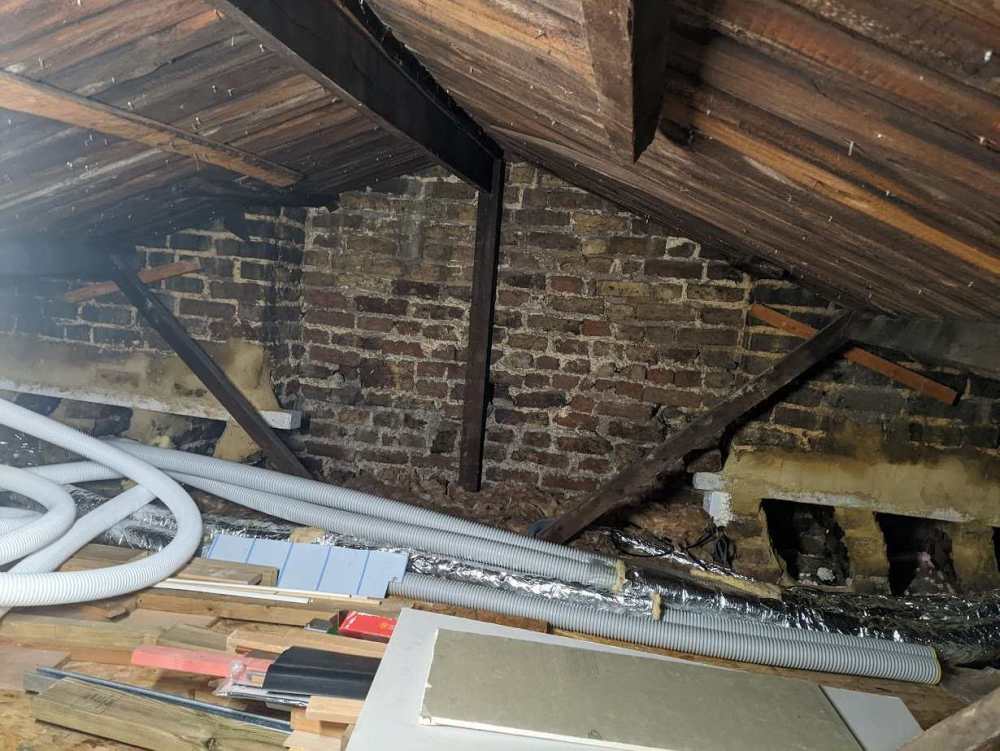
I started a DIY MVHR build as I wanted to make my house a bit more insulated, but already have condensation on windows and smells that linger for says, so it seemed like a sensible next step. My attic is cold, but the only place I really have space for a unit, and figured I could insulate the chimneys at the same time as passing MVHR pipes down them (after putting in a lintel) - 3 chimneys front and 3 at the back for a 3 story mid-terrace house of ~140sqm. The chimneys are pretty warm now I have insulated them at the attic (no external walls), and added small breather vents into the house. I have mostly insulated the ducting in the chimney and will of course do the same in the attic once I have finalised manifold locations, and probably the MVHR itself given it's a cold attic. There are some rooms I still need to work out the semi-rigid duct path (no chimney to use for several rooms), but Im starting to think about next steps and would love to hear your thoughts/concerns please? Im planning to put the MVHR in the middle of the chimneys, and the semi-rigid ducting can all meet at some manifolds there quite easily. Do you think it would be best to wall mount with some brackets, or just put some wooden joists to support its base? If I put the external vents through the chimney then there will be a lot of bends to deal with (around the roof supports and going down to the opening for the chimney before going up the chimney to some form of cowl). Would I need a drain point at the bottom of this ductwork, or is it generally ok so long as the ductwork is insulated? My alternative is to ask a roofer to cut a hole in my roof and put the external vents directly above the MVHR (and could then totally remove chimney at some point - given I think I can see water marks on the chimney above the lintel it presumably needs some work anyway). Is this worthwhile do you think? (shorter pipework but more invasive and risky to interfere with the roof, given somebody in the past made the strange decision to add planks added on the back of the roof) A Zehnder Q350 is an impossible squeeze through my roof hatch at present, but I may cut the hatch just to allow entry and then re-seal... Though definite effort! Alternative options with a width <510mm seem to sacrifice a fair bit. The Zehnder needs 160mm vents, but if I used 200mm vents could I use flexi pipework to make the routing easier (due to the above), or would I need more like 250mm to compensate for all the ridges....? (the chimneys are about 240mm wide, but quite sooty, so definitely needs lining) Any thoughts or feedback very much welcome, thanks in advance!
-
Thank you both, I dont know why I didnt see this response despite being subscribed. I think a slimline cylinder would fit, but definitely harder as it needs the extra expansion vessel, but I was more curious about the actual differences from an efficiency POV. Perhaps I have to try and make some assumptions and build a model myself, but was interested if anybody else had thought about it! Thanks again!
-
Long time lurker but have a pretty good knowledge of ASHP now. I am pretty close to confirming final details of my installation, but I have a 600x550x2200 cupboard for the internal gubbins, hence space is TIGHT and installation companies have questioned what is possible! I wondered whether there was somebody in this group who had more details about the HG Mini Store Running Cost and COP (I can probably fit the largest 110L version). Given its design, I guess the following are true: 1) The heatpump needs to maintain the higher temperature while drawing water, so whilst you might normally have a cylinder running from 15 up to 45 when refilling an empty cylinder, the mini store can only be fed by 45 degree water for it to work, so reducing potential COP. 2) Rather than being able to draw down the whole tank before refilling you need to re-heat immediately or the water rapidly becomes unusable, even for the larger tank... hence further reducing COP due to cycling. Though perhaps there is enough thermal mass that the temperature doesnt drop that much... (or use a higher store temp which exaggerates 1+2. 3) The heatpump needs to run the when there is demand (rather than offpeak) hence the electricity might also be more expensive than on a normal cylinder. 4) It is smaller so has lower heat losses and doesnt need an expansion vessel (or perhaps just a smaller one....?) 5) Given it doesnt store water very long you dont need to run a high temp legionella cycle weekly.... No idea where this nets out at, in terms of money and efficiency, and possibly depends on your usage of it, but was curious if anybody had any other thoughts, or more detailed numbers!? Thanks very much