AndySat
-
Posts
19 -
Joined
-
Last visited
AndySat's Achievements

Member (3/5)
6
Reputation
-
Brilliant, thanks! I can live with a single 3", much easier to route than 2 x 110mm. I may also get an AAV for the kitchen, we fitted one in our last house to solve a problem with gurgling when the sink was emptied (although that was an island sink and the waste pipes were a bit like spaghetti junction).
-
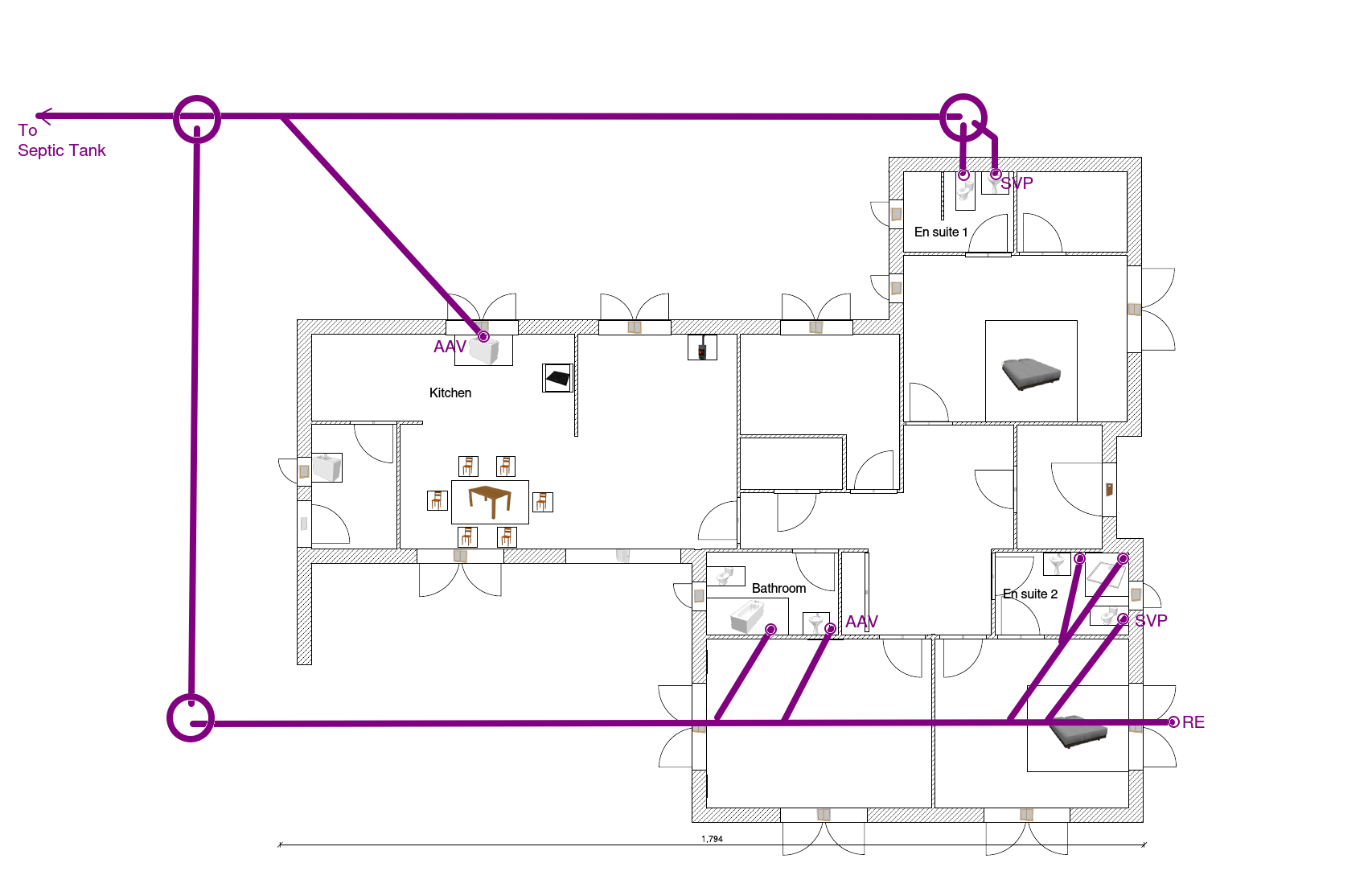
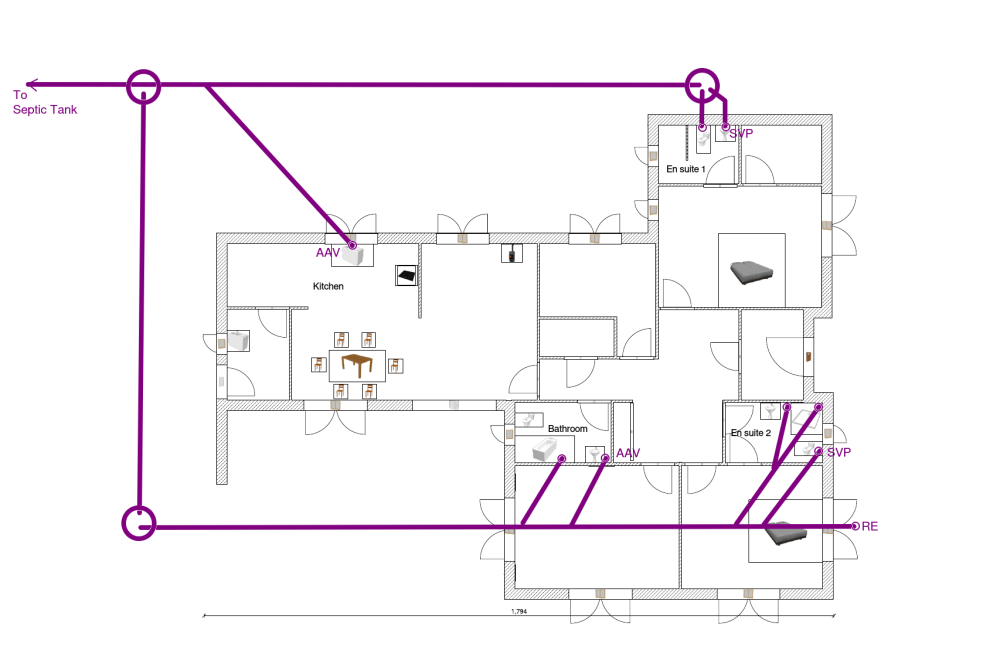
I'm starting to plan for the roofing on my build and one of the questions the roofer had was how many SVP will be needed through the slates. Am I correct in thinking that only the end of each branch needs an SVP? I recall some disussion about AAV instead of SVP and I'd like to avoid vent pipes through the roof as far as possible - less boxing in and less problems with air tightness. Diagram shows how I think the soil pipes are routed (inspection chambers are currently under scaffolding so I can't check, but hopefully more or less correct). NB the bathroom layout is not yet finalised, hence the apparent lack of soil pipe to the toilet! Thanks!
-
I like that idea! I'm a bit sceptical about electric UFH in an area that gets wet regularly, but apparently it's ok if done properly. The shower in question is a walk-in with a recessed former. I'll be looking at this UFH option when I'm a bit further along in the build.
-
Any reasons not to go with a Nibe ASHP?
AndySat replied to Great_scot_selfbuild's topic in Air Source Heat Pumps (ASHP)
Understood. I just wanted to make the point for anyone who's looking for a more hands-on system, where there's more flexibility in terms of connectivity. -
Any reasons not to go with a Nibe ASHP?
AndySat replied to Great_scot_selfbuild's topic in Air Source Heat Pumps (ASHP)
My two cents worth: I've been comparing ASHP specifications for far too long in the process of making a choice for my build. One of my criteria is the quality of the manuals and NIBE are good in this area. As mentioned, a lot of manufacturers don't give much info about the minimum outputs, but this data is in the NIBE installation manual (at least for the F2050 that I was looking at). My concern about the NIBE was that it doesn't seem very DIY-friendly. It can obviously do everything (smart grid, inverter integration, machine learning, integration with MVHR) but only if you have a compatible inverter, MVHR and a bunch of NIBE smart controls. I prefer systems that support a more open approach e.g. modbus or volt-free contacts to control these functions, but that may not be relevant for everyone. -
I think this is going to be a problem in my build as well. The floor area is small, even before I deduct the space taken up by the shower, toilet, handbasin etc. Probably it will just be a case of as much UFH pipe as will fit and add some extra heat with an electric towel rail when needed. As long as the floor doesn't feel cold to walk on, it should be acceptable... Actually, I'd like to get some UFH pipe under the walk-in shower, but that might be ambitious! Interesting! I am planning to use the SG capability to soak up any spare solar power, either by putting more heat into the slab, or pushing the DHW temp up a degree or two. But this is just a concept at this stage, I suspect it'll take at least the first year of actually living in the house to understand the trade-offs between putting solar power into the battery, or the ASHP, or selling it back to the grid. For now, I'm just making sure that these options are possible i.e. the necessary capability/connectivity is there.
-
Thanks. That's what I was hoping (although it makes the UFH calculations more complex). The Haier ASHP will flow down to 20C, but this is below my 22C target temp of the bathrooms. I think I've got enough data now to choose a suitable ASHP. Next step is the UFH design, but I'll take that into one of the existing threads to keep things simpler.
-
Well, almost a year later and a lot has happened... Build has started and the groundworks are more or less done. Timber frame kit is due to arrive in March. So I'm looking at the ASHP & UFH design again. I'm a bit reluctant to delegate the design work to a specialist ASHP contractor as the two I've spoken to so far have suggested standard designs that either have multiple zones (one per room, complete with separate thermostats) or are massively over-specified for the house. Its only 140 m2, single level and very well insulated with MVHR, but one of the designs has a 8.5kW ASHP! Presumably these contractors would make a more accurate assessment once some money changes hands, but they don't fill me with confidence! My own room-by-room calculations and Jeremy's spreadsheet suggest a total heat requirement of about 2.8kW worst case, dropping to about 1kW best case. A 4kW ASHP seems about right, with some margin at the top end (and for DHW), but how many will modulate down to 1kW? I've read every datasheet I can find, but very few manufacturers specify their minimum outputs. The 4kW Haier R290 that @JohnMo has just installed does indeed give this info: it will modulate down to 996W at +10C OAT and 35C flow, so this looks like a good fit for my case - it should be able to run without cycling for most of the time. I'm interested to know how an ASHP actually modulates its output. Does it reduce the flow temp, while keeping the flow unchanged, or does it reduce the flow and keep the temp unchanged, or both?
-
Domestic Client's responsibilities (again)
AndySat replied to AndySat's topic in Project & Site Management
Thanks all for the responses. I'm getting a better idea of what's going to be needed on my project. I should have said "phases" instead of "sections". The project has some obvious breaks e.g. groundworks, timber frame, roofing and these will likely be different contractors, so it would be feasible to have them on site one at a time. Whether they accept the PC role is another question. Maybe not, although they become the PC by default if one isn't appointed. -
Yes, it's another thread about Domestic Clients and CDM... I've read the excellent summary by ToughButterCup, which answers a lot of questions, but this is well outside my comfort zone, hence the request for advice. After a long delay, my self-build project is about to kick off, with groundworks starting in the coming weeks. Not ideal timing, but that's how it ended up... In traditional self-build fashion, I intend to split the project into sections, each with a different contractor, so there should only be one contractor on site at a time. As a Domestic Client, I won't be the Principal Contractor, so this role will fall to whichever contractor is on site. I will make it clear to each contractor that they are responsible for their own H&S and meeting the CDM requirements. As I see it, this means that: - I can tell the contractor what is expected (in a statement of work, specification, etc) - I CAN'T tell the contractor how to do it (since this isn't my area of expertise and could be seen as "controls the way in which construction work is carried out by a person at work") - I can ask the contractor to explain what they are doing and to show that their work meets the specification. Of course, this could be seen as telling them how to do the work if it's excessive, but some level of monitoring must be acceptable. - I can provide some facilities on site (e.g. toilet, skip, welfare unit, etc), as long as the contractor agrees that they meet his needs, otherwise he provides his own facilities (and bills me accordingly!) Hopefully this is mostly common sense, but if I've got anything wrong, or if anyone has any relevant advice/experience, please comment! Thanks
-
Well, in the time-honoured tradition, my soakaway is going in the field next door, which we own. Looked again at the papers provided by my neighbour and his assessed soakaway required is 93m2, which apparently corresponds to a trench 155m long! I'm not sure what the engineers would typically do in this case - dig a long trench or loop it back a few times? I managed to get 10m of drain rods into the pipe leading away from the inspection chamber without any resistance, so I'm hoping that it's a long linear soakaway and not some kind of herringbone design. But it looks like I'll need to get a sonde and/or camera in there to see where it goes...
-
Thanks both. My neighbour found some paperwork that confirms that it is the soakaway for their septic tank. The plot was part of a field when his house was built, so this was probably the easiest option back then. I lifted the cover and found two pipes as expected, one heading in the direction of the neighbour's house and one leading onwards somewhere. Paperwork shows the soakaway is a porous pipe in a gravel bed but doesn't say how long or where it goes - I assume in a straight line away from the inspection chamber. I'll see if I can get a rod in there tomorrow and find out more. I'm not too concerned about the manhole itself, but it's going to be tricky moving the garage 5m away from the soakaway and still meet the planning requirement for parking and turning space...
-
Apologies in advance for a newbie question.... I'm looking to build a detached garage (part of a bigger house build project, but that's another story) at the side of the plot nearest the road. So far, so good, but there's a manhole cover towards the edge of the plot, close to where the back wall of the garage will be. It's an inspection chamber for the neighbour's foul drain soakaway. Of course, it's not on anyone's plans and he knows nothing about it. Leaving aside the question of whether it should be there or not, how close to it can the garage foundations be? It's likely about 15 years old, so probably just a big hole filled with stone rather than plastic crates and it seems from the slight depression in the ground to lead in the opposite direction to where I want to build. We had an engineer on site for the soil stability tests for the house and he didn't seem too bothered about it, but I'd like to understand whether it's a potential show-stopper, or something I can work around with e.g. deeper foundations and lots of concrete! Thanks!
-
I agree. Having a standard unit is probably a good thing in terms of price and reliability, but my current thinking is to go with a monobloc - simpler and uses less space in the plant room. Plus it puts any potentially noisy bits outside. The UFH will be a single zone and based around WC instead of thermostats. But I may hedge my bets and at least run the wiring for a thermostat in the bedrooms...
-
I might be missing something, but my reading of the Home Energy Scotland Grant and Loan terms is that the grants are for improvements to existing installations and don't apply to new builds. It's not permitted to install oil or gas boilers in new builds, so perhaps there's no need for an incentive to install heat pumps? I have to admit that the question of noise never occurred to me when I started researching ASHP. I'm aware that some older external units can be a nuisance to the neighbours (not in our case though as the location is on the opposite side of the house) but I assumed that internal noise wasn't a problem. One of the ASHP contractors offered to show me around one of their recent installs, so that might give me an idea of how noisy it is in practice.