New to this
-
Posts
29 -
Joined
-
Last visited
Everything posted by New to this
-
DNO curve ball - Section 37?
New to this replied to New to this's topic in New House & Self Build Design
I believe, from what I discussed with them yesterday, that it's the line itself that determines the situation - and the line to the last pole is a full up 23kVa, the inspector's words were "it's ludricous - that's enough to power about 20 houses, and you only want one". I didn't ask them to consider downgrading the last leg from 23 to 20 or below; my instinct is that would be, as a minimum, a new transformer required, and potentially more complexity / cost / delay? My current workaround is to throw myself on the mercy of my nearest neighbour, ask if I can trench from their pole to the utility verge (I'm sure that's not what they're really called!) and come down the roadside then directly into my plot. It was galling to hear that this legislation is likely to be removed "sometime soon", but not within the timescales of my project - Murphy's Law is how it felt! -
DNO curve ball - Section 37?
New to this replied to New to this's topic in New House & Self Build Design
@ProDave I have tried reading it ... it's not written in plain English! https://www.legislation.gov.uk/ukpga/1989/29/section/37 if you're interested. Google interprets it as: Section 37 of the Electricity Act 1989 requires formal consent from the Secretary of State (or Scottish Ministers) to install or keep installed overhead electric lines above ground. This statutory requirement covers new, amended, or continued operation of lines, primarily those with a voltage exceeding 20 kilovolts (kV). Key aspects of Section 37 include: Purpose: Ensures overhead power line projects are properly reviewed for environmental and local impacts. Application Process: Involves consultation with local planning authorities and statutory bodies (e.g., Natural England, Environment Agency). Exemptions: Consent is generally not required for lines with a voltage of 20kV or less used for supplying a single consumer, or lines on premises already under the control of the operator. Planning Alignment: Often works alongside "deemed planning permission" under Section 90 of the Town and Country Planning Act 1990. Non-compliance: Unauthorized installation or maintenance can lead to legal penalties. It is crucial for network operators to obtain this consent before starting overhead line projects unless specific exemptions apply. My supply line is 23kVa so outside the exemption range. I do feel my DNO (SSEN by the way) have - perhaps - taken the worst possible view and I was not heartened to hear that other DNOs do not all appear to take this interpretation. Apparently though, the DNO will not be budged, their legal team will not allow any other approach. -
DNO curve ball - Section 37?
New to this replied to New to this's topic in New House & Self Build Design
@MPx well done - great result in a tricky situation. My inspector suggested that his DNO were misinterpreting the 1989 legislation and that I shouldn't have this issue at all - who is the DNO for your part of the world, out of interest? Sounds like they have a more pragmatic approach, albeit you've gone around the situation a different way. Mine won't allow me to put a new pole off the last (current) pole. SO frustrating! -
DNO curve ball - Section 37?
New to this replied to New to this's topic in New House & Self Build Design
@NSS not stupid at all - that's exactly what we discussed when the site inspector came today. All depends on the neighbour now to grant permission to use their pole and dig their garden - great shout though -
DNO curve ball - Section 37?
New to this replied to New to this's topic in New House & Self Build Design
Thanks Roger, I will look into that - no harm in researching it -
DNO curve ball - Section 37?
New to this replied to New to this's topic in New House & Self Build Design
@MikeSharp01 when you talk about Planning in this context, what were you thinking please? I'm not getting any sense from the DNO that I need Local Authority involvement (unless Highways end up being involved) - I think it's a case of waiting for the relevant government department to (hopefully) rubber stamp the application. I could, of course be very wrong! For context, I have full planning permission for my development and groundworks start next week. For the last couple of years, the DNO have consistently told me to "wait until I am just weeks away from having the building up, into which the supply will run and smart meter be installed" which is how I'm only finding out now, from the site inspection side of SSEN that there's this issue with the 'last property on the line". -
DNO curve ball - Section 37?
New to this replied to New to this's topic in New House & Self Build Design
Thank you, such a good idea but sadly we're on a low voltage single phase line down a country lane! -
DNO curve ball - Section 37?
New to this replied to New to this's topic in New House & Self Build Design
I love obvious questions - they are the ones I usually overlook!!! No the 'other' direction is hugely expensive due to distance, complex due to actively agricultural fields between us (which increased cost due to depth of excavation 1000mm instead of typically lower amounts. -
DNO curve ball - Section 37?
New to this replied to New to this's topic in New House & Self Build Design
Self sufficiency? Sadly roof shape isn't ideal for that option and we're heavily shaded on the East-South. We had hoped for a modest array on three sides of the hipped roof, but nowhere near what we would need. No mains gas (rural). -
Hi, not sure which forum was the right one so opted for this one. Our new build is in the garden of our existing bungalow, the last property on a low voltage line. Despite over 2 years back and forth with the DNO for quotes for the connection, I've discovered today that they can't do my connection without it going to Parliament (??) to the Secretary of State, under the 1989 Section 37 legislation. The existing bungalow, being the last of the line, and despite having a main electricity line to the pole outside, is not allowed to be followed on by any further build, without said sign off. Which apparently typically takes about a year. I am adding this in as an edit - I don't think it's the Sec of State, reading this from the DNO's own website:- A Section 37 application is a two-part process involving an initial application to the local planning authority followed by an application to the appropriate Ministry:- Scotland - Scottish Government Energy Consent Unit England / Wales - The Department for Business, Energy and Industrial Strategy There are certain circumstances where a supply may be provided to a single customer at less than 33kV without the need to obtain a section 37 Consent. In these situations, it is still necessary to consult with the local planning authority before constructing the line. Where an existing line serving one customer is subsequently required to serve further customers, a retrospective Section 37 Consent will be required. Section 37 consent can also apply in cases where underground cables are being installed from an existing overhead line, where retrospective Section 37 may be required. Where it is necessary to modify an overhead line, Section 37 may be required or in certain circumstances, works may be carried out under the provisions of the requisite Overhead lines (Exemption) Regulations. To say I'm reeling is an understatement. I'm desperate to research whatever I can find now about others who've maybe found themselves in this position, did you manage to deal with it, how, costs etc and what on earth can I be trying next!? Apparently "the quote team should have spotted this" ... but I can see no advantage in my pressing the red button with the DNO, it won't alter the position I'm in now, nor the timescales to overcome it.
-
Excavation levels on clay ground
New to this replied to New to this's topic in General Structural Issues
Our perc test failed for soakaways, so our planning has insisted on all surface water being piped into a drain with a rumble strip and then on out to the ditch. Aren't we fortunate?! -
Excavation levels on clay ground
New to this replied to New to this's topic in General Structural Issues
Thanks @SimonD - I didn't know about the Type 1 vs 3 thing. Is that in the BRegs? My site is quite a decent size and there will be about a third of an acre left after build for water to run off to, if that makes sense, but I've no idea about this stuff and it does concern me I'll run into issues with BC inspections and sign-offs! -
Hoping you experienced folk will guide me; how do I research / know what is the 'correct' ground prep for excavating - in this case specifically site access (needs widening considerably as all construction vehicles need to get from single track lane onto site currently entrance <10m wide) and then the 30+m of sub base that will eventually be finished as our new driveway and also the 2m perimeter around the house for scaffolding, and later for pathways? I haven't chosen a final drive surface yet. Two builders have given figures but I can't compare them as one goes down 300mm while the other 400mm (this is to lay geotextile, then hardcore, then Type 1 compacted, in case that makes any difference). I want to spend the 'most minimum' I can on this without compromising quality; it needs to last once driveway is topped with whatever the final finish is, but I don't want to throw money I don't need at it either. Ground is very high plasticity clay, if that makes any difference.
-
Hoping you experienced folk will guide me; how do I research / know what is the 'correct' ground prep for excavating my access (needs widening - a lot - from single track lane onto site) and putting down the hard standing that will eventually be finished as driveway and also the 2m perimeter around the house for scaffolding, and later for pathways? I haven't chosen a final drive surface yet. Two builders have given figures but I can't compare them as one goes down 300mm while the other 400mm (this is to lay geotextile, then hardcore, then Type 1 compacted, in case that makes any difference). I want to spend the most minimum I can on this; it needs to last once driveway is topped with whatever the final finish is, but I don't want to throw money I don't need at it either. Ground is very high plasticity clay, if that makes any difference.
-
Alterations to detached double garage design
New to this replied to New to this's topic in General Structural Issues
Really appreciate the input @Nickfromwales, @Russdl and @BotusBuild - we are sticking with ONE BIG DOOR 🎉 -
Alterations to detached double garage design
New to this replied to New to this's topic in General Structural Issues
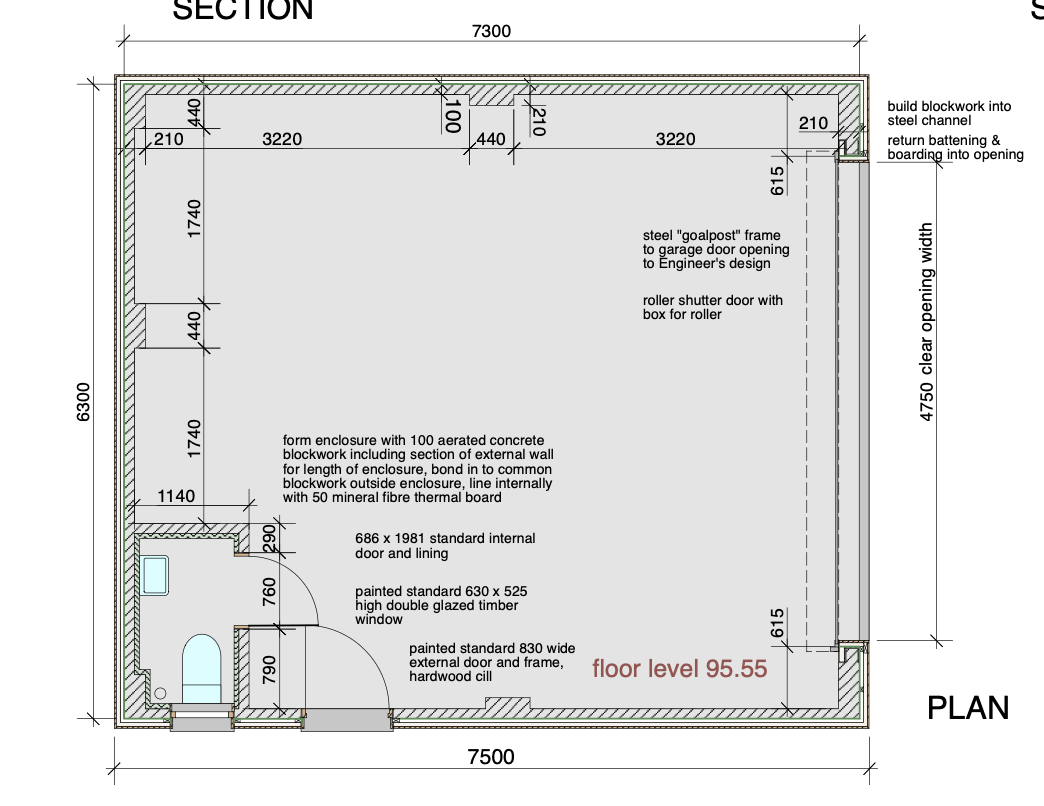
@Nickfromwales I think this may help - there's width to add the central pillar, by reducing the two side returns. All the supporting pillars around the permeter will be tied in as they are built. At our previous house, we had the garage in the photo - the pillar isn't massive. Apparently the concern now being expressed within the New To This household is that pretty much the entire width of the garage is exposed to the elements once that single door is opened, I personally don't see it as an issue, but it's Himself's baby, not mine!!!! His precious chariot will live in there, alongside the tractor mower and a few other bits. There's a separate pedestrian door in/out as well. @BotusBuild, I wouldn't put the goal post in if we are going for two single doors, simply the normal lintel over each opening. I should have added images at the start, would have made it a little more evident for all what I was getting at.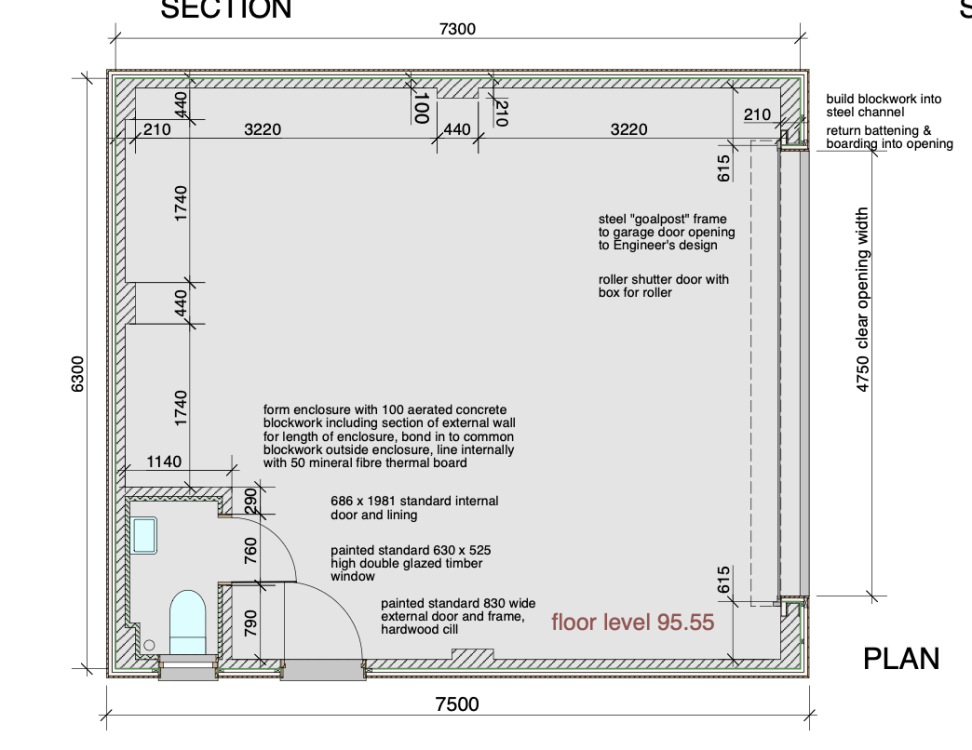

-
Alterations to detached double garage design
New to this replied to New to this's topic in General Structural Issues
Definitely where my head's at - but as a total novice, I don't know if a decision like that 'now' has consequences down the line! Thanks for sharing your view BotusBuild -
Alterations to detached double garage design
New to this posted a topic in General Structural Issues
Hoping you can point me in the right direction - our plans all drawn up by previous architect, approved by local authority planning department and foundations/steel work calcs completed by our SE. We now wish to switch out the planned 4750mm-wide large roller door in favour of two more typical (about 2.4m each) doors. What do I need to organise next for this to all work out ok? Will I need to go back to the SE, to get the steel goal post structure replaced with 'just' appropriate lintels, or can builder simply get on with that? Aside from the planning angle, what other impacts should I be considering here? It's a block single skin structure with double block pillars at appropriate points around the perimeter. I'd now look to block or double block the central supporting 'wall' between the two new openings, and sit the lintels on those. The already-designed structure has double blocks on left and right hand side of original large door anyway. We are likely to have LABC and self build warranty in place, we plan to build this structure first, to provide on site storage / welfare etc while house is built. -
Hi Russell, I don't have the drawings for the DAN-wood house just yet; however I have the drawings for the previous timber framed house. That was as I described - made my eyes water!! 1.9m deep closest to hedge on strips 750 wide, graduating back to 1.1 deep on 500 wide, then the B&B with a huge void and finally a reinforced slab. That was for a passivhaus, but I'm not sure I should hope for it to be any different now, and I'm sure the D-W spec on site prep says something like 'do your SE-designed foundations, then cast a slab over the top to this specification' ... my computer's playing up just now, and won't let me access the files I wanted, to share more info.
-
Full virgin clay, three trial pits from 1-1.5m depth showed only blue/grey with occasional orange tinges of clay under a silty topsoil no more than 200 at most deep. This land was agricultural for a minimum of the last 100 years, as we know the farming family who had it. I need to go and read up on structural slab versus anything else ... our design to date has reinforced strips foundations, topped with blocks and beam, above a void of 300mm, then an insulated slab on top of that. Pricey!
-
Thanks for replying so very quickly. Our architect did suggest we could remove the hedge completely, but we don't want to (nor can I imagine the Planning Dept being at all happy!)!! And I completely agree with you regarding the risks of neighbours planting whatever they like on boundaries ... oaks and willows seem to be the worst possible tree species especially on clay from the viewpoint of how much they drink from especially clay soils.
-
@Rosslyn that's so good to hear. I wonder if you have the geo-tech results and would feel able to/happy to share with me? I'm just pondering whether it's an investment for me to get a different SE's take on the design - it's not that I have any reason not to have blind faith in my SE, more that I haven't a clue about the subject, and pondering would a different SE perhaps have a different take on the information. I have a set of lab results from our geo-tech survey that show our ground ranges from the highest category of "High" plasticity, up the middle of the "Very High" range and I believe it's this that is blocking our preference for an insulated raft solution.
-
@saveasteading the structural engineer said because of the species, they had to be accounted for even though it's a hedge we own / control. It's about 2m wide, as a hedge, and the building is going to be about 7m from the inside edge of it. The specific species are hawthorn, blackthorn and field maple, if that's of any use?!
-
@Rosslyn just wondered how you got on with your foundation design? We too are getting close to that stage; highest plasticity clay and a hedge the full length of the house with tree species has me a tad worried!!
-
DNO reneged on quote for new connection
New to this replied to New to this's topic in General Self Build & DIY Discussion
That's super helpful, thank you very much. They've now said £7K, they will give me my connection. Still staggered at £7K when I'm doing 90% of the trenching - literally - but I don't think I have any choice do I? Who would I even complain to about the DNO quote ... it's a monopoly situation isn't it?