
Happy anniversary darling…

Entry posted by G and J in The house itself.
22 views
Should I even call you darling?
Probably not, but as you (not you specifically, sitting there in your ‘should have been put in the wash weeks ago’ dressing gown, I mean the buildhub fraternity) have been so great a moral support I can’t help feeling some degree of affection.
Anyway, there’s no chance of me drawing breath this week, or any week till we move out of the ice box (AKA rental - and thats the polite version, I now have a different name for it), so if I’m going to mark the year in point it has to be now, as a year ago on Tuesday I clambered up onto the roof of da Bungalow and started sliding tiles at my mate Steve.
I miss him. He’s not dead or anything - though his dress sense would tell you otherwise - but he’s off the project and that isn’t comfortable. He buggered his shoulder blocking up to damp and hasn't been back working on site since. He still visits to let me know that it’s not up to standard and we should be further on, so basically all the things I know already, but it’s not the same as working together. That was rather fun. In a twisted way.
So, how far has a year got us?
Insides are plastered out and oven ready for our mist coats, which hopefully start Monday. I’m hoping we’ve no buried leaks or missing cables, time will tell.
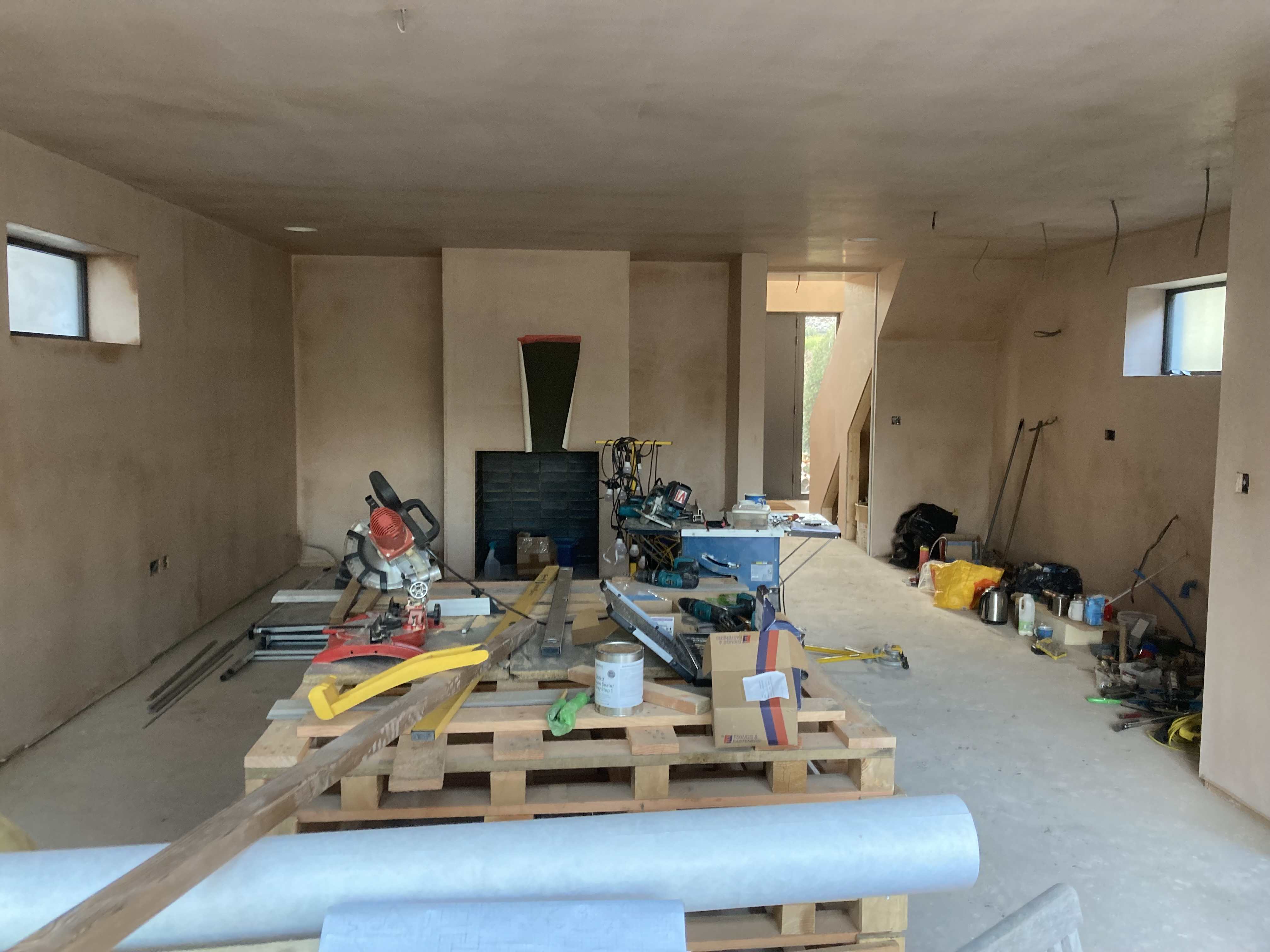
Outside a small groundwork’s team are half way through connecting the house to the drains. When I dug down to find the capped sewer pipe it looked closer to the surface than I remembered - which featured in the playlist of yet another sleepless night. I’ve quite a wide repertoire of tumble dryer worries, yet another talent courtesy of the build.
Thankfully it turns out my water level did me proud and the poo pipes protruding from the house are at the predicted level with respect to the sewer so happy days.
It’s really odd building a plastic bag to live in. OK, it’s a well insulated plastic bag, but it’s still a really big plastic bag. It’s beautifully illustrated by our breathing ceilings.
We continued the hideously gaudy coloured VCL up the side walls and over the ceilings, putting in as few staples as we could to reduce the number of penetrations. Eventually the house itself was sealed up bar the missing front door and loft hatch. We took the precaution of putting the first layer of loft insulation up to avoid condensation on the ceiling VCL, using “Industrial polypropylene strapping” stapled to underside of the joists before the VCL was put up, so the strapping took the weight rather than the VCL. It worked a treat and even allowed insulation to be laid even where the VCL hadn’t been done.
Standing upstairs a weird thing constantly happened. The VCL above us very slowly rose and fell - it was as if the house was breathing. Oddly mesmerising. I should have recorded a video.
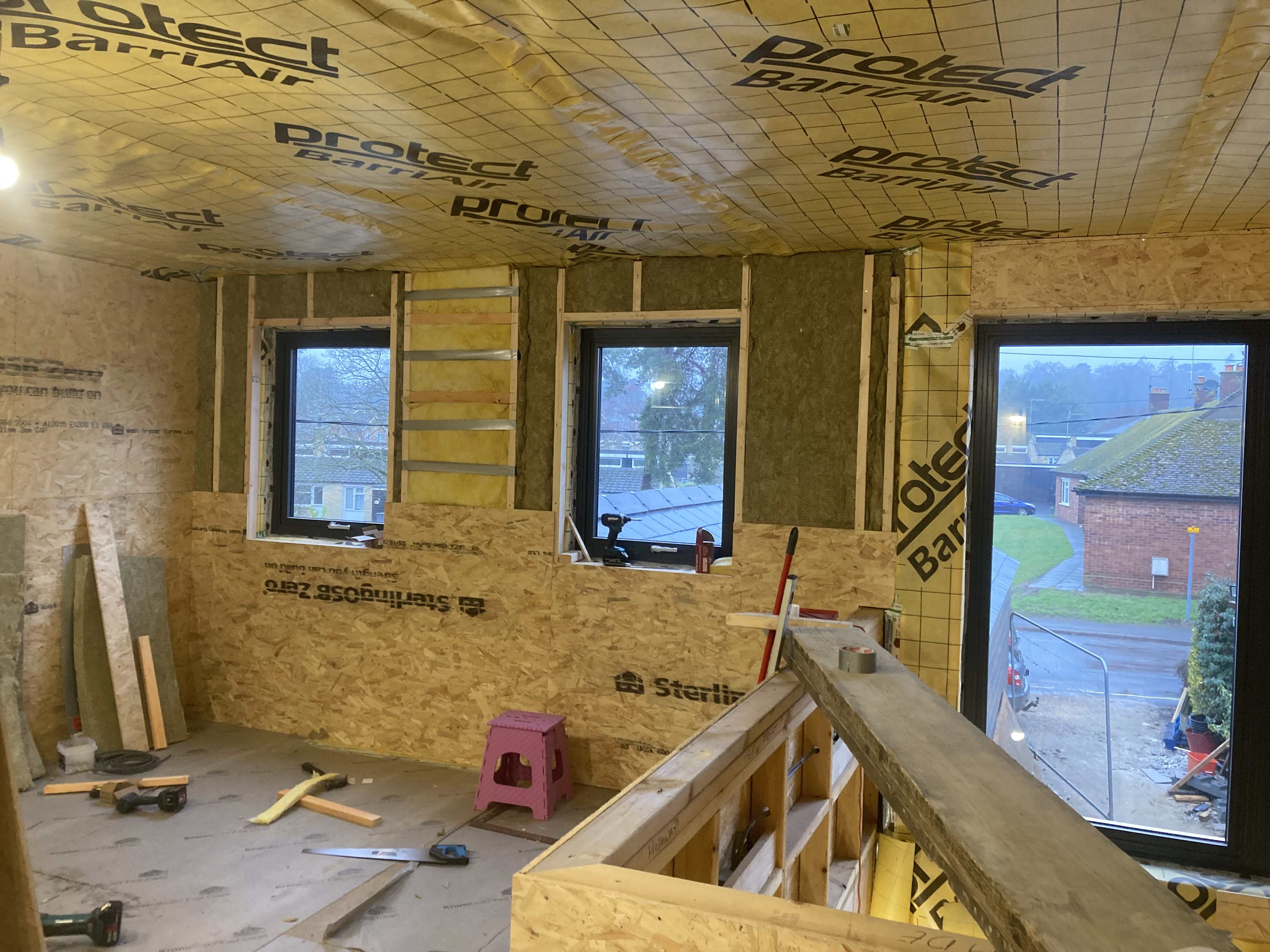
But there was no time to stand and look. The plasterer had lots in his books so couldn’t get to us till the end of January, so we took that as our target. We had no way of knowing if that was doable (it wasn’t) but the concept was that by setting a target we’d go faster so we charged up the cattle prods.
I thought I knew it would be stressful being driven by such a deadline. As in so many build things I had underestimated badly, however.
Some things went better than I’d expected. I’d planned to pull in the wires myself but instead Steve the Sparks (the confusingly named son of Steve of the buggered shoulder who did the demo and the founds with me) did it all in a couple of days. The speed of the man, but oh, the radio!
He was the first of several with the ubiquitous Makita site radio playing ‘80s stuff. We’d been a no radios site till then. But we had by then lots of fluffy insulation, so I relented as long as it was on indoors only and relatively quiet.
And having said yes to one it’s a lot harder to say no to others so the tackers (plasterboarders) and the plasterers all followed suit. Did I really need Bananarama on a loop in my head with everything else whizzing round?
Another thing that went well and a quicker than feared was pulling in the water pipes. On the odd moment I was alone on site it took very little time to actually pull the HEP2O pipes through. OK it left a mess of tails above the cylinder but that could be left till after the tackers started.
A lot of things got categorised as ‘after the tackers get started’, which was sensible but not always satisfying.
The theory of radial plumbing, no joints buried, I found seductive. However the theory floundered when it met the Aqualisa buried shower and bath controls. That continues to cause me angst and will do until I’ve finally accepted that I’ve dealt with the last wet patch (yes, technically it’s called a recurring nightmare).
One thing that didn’t go so well was the vent ducts. It wasn’t helped by the fact that I’d decided to go for 90mm rather than the smaller version and we’d ended up with 253mm metal web joists (pozis) rather than the 304mm I’d planned. It also wasn’t helped by a glulam blocking the ideal route from the main house into the loft above the downstairs bedroom.
So it was a fiddle, (polite version) and the pressure was on as the duct itself only arrived on the 28th of January, mostly due to a supply issue.
I’d thought long and hard about duct routing, but things are never as one imagines. The MVHR unit will sit in the garage next to (but not touching for fear of noise) the wall of the downstairs bedroom. All duct pass through the loft above said bedroom and then enter the house itself.
That loft is a disturbing piece of modern art. I’m glad that I will never see it again (fingers crossed). Fifteen 90mm corrugated white tubes bound together wrapped in fluffy brown insulation snaking through the trusses. Where they pass into the house there is a Quatermass of airtight foam, as if the house was punctured by the hydra and it bleed green goo. Getting the insulation up there was surreal. It’s a v restricted space and the only way to do it was to poke my upper body through a gap in the ceiling VCL and distribute the insulation. It pretty much fills the loft now. When I start sleeping properly again I’ll have nightmares about all that.
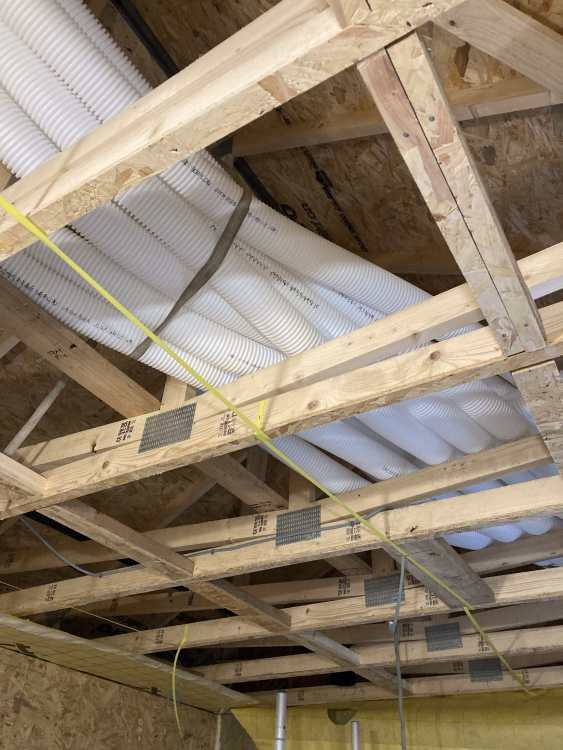
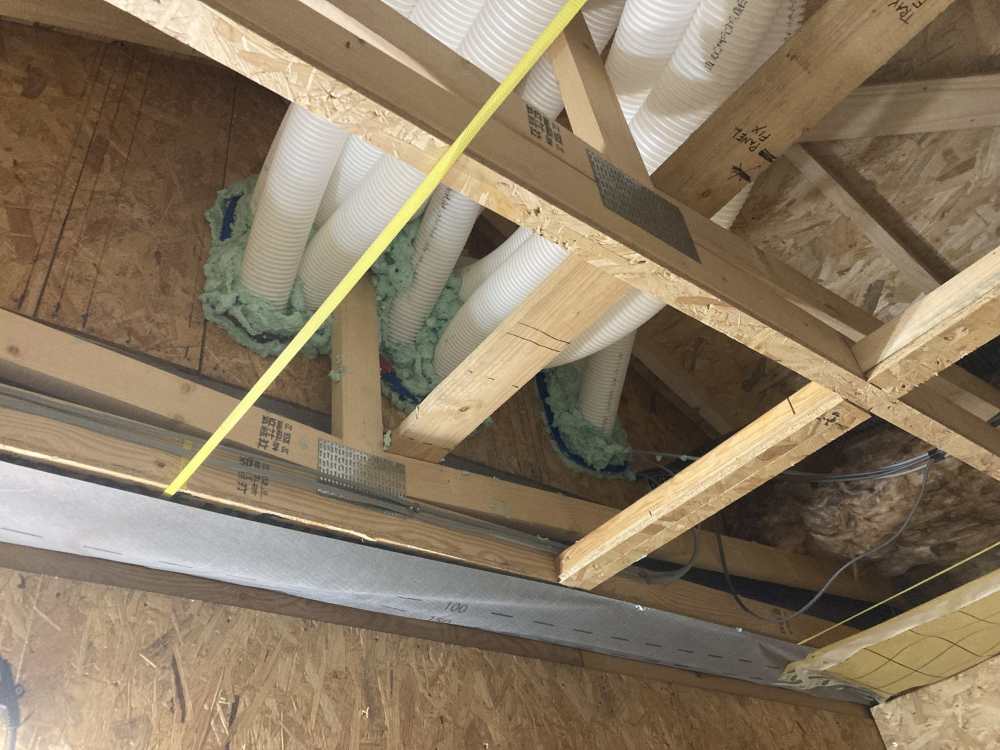
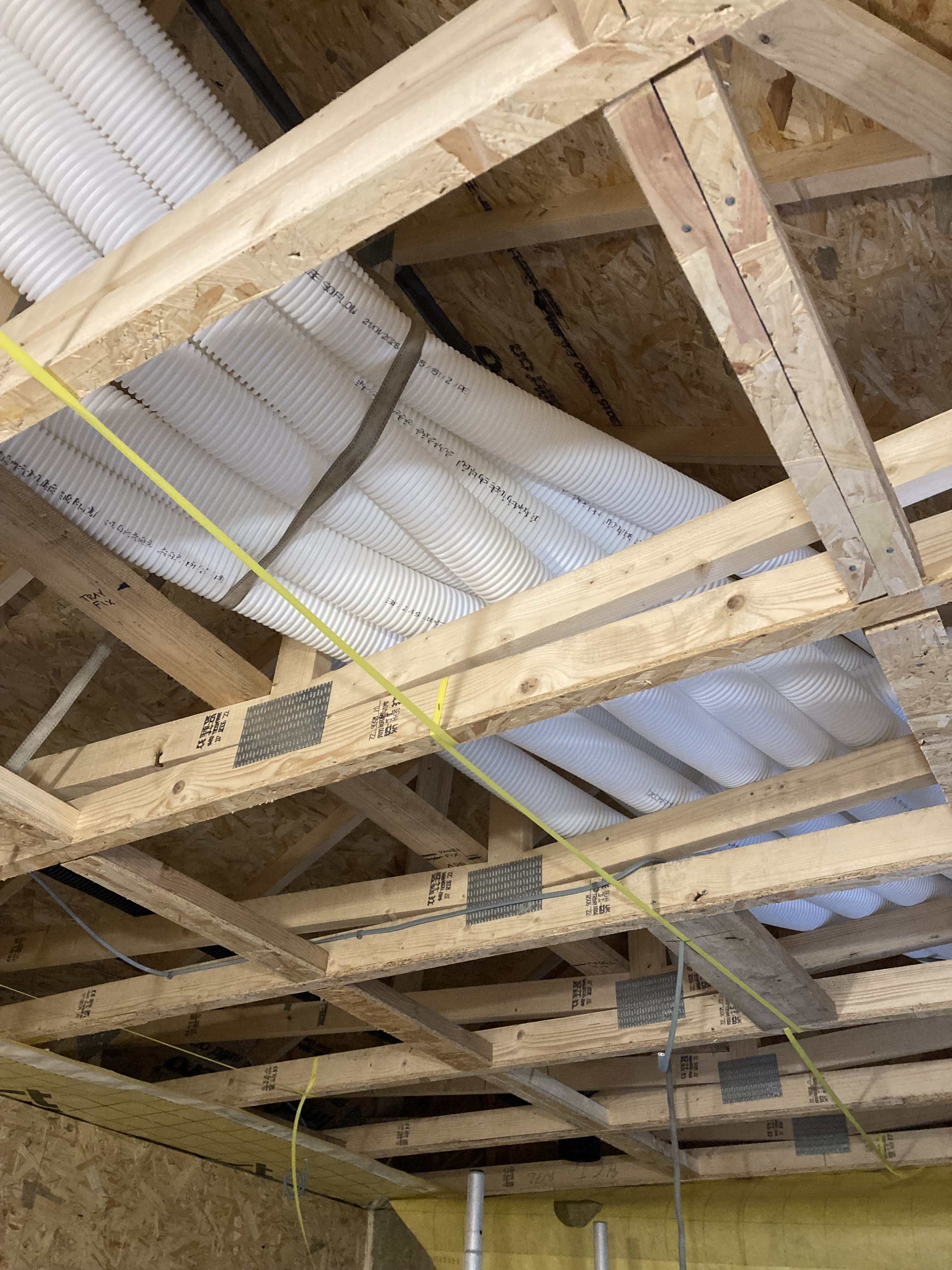
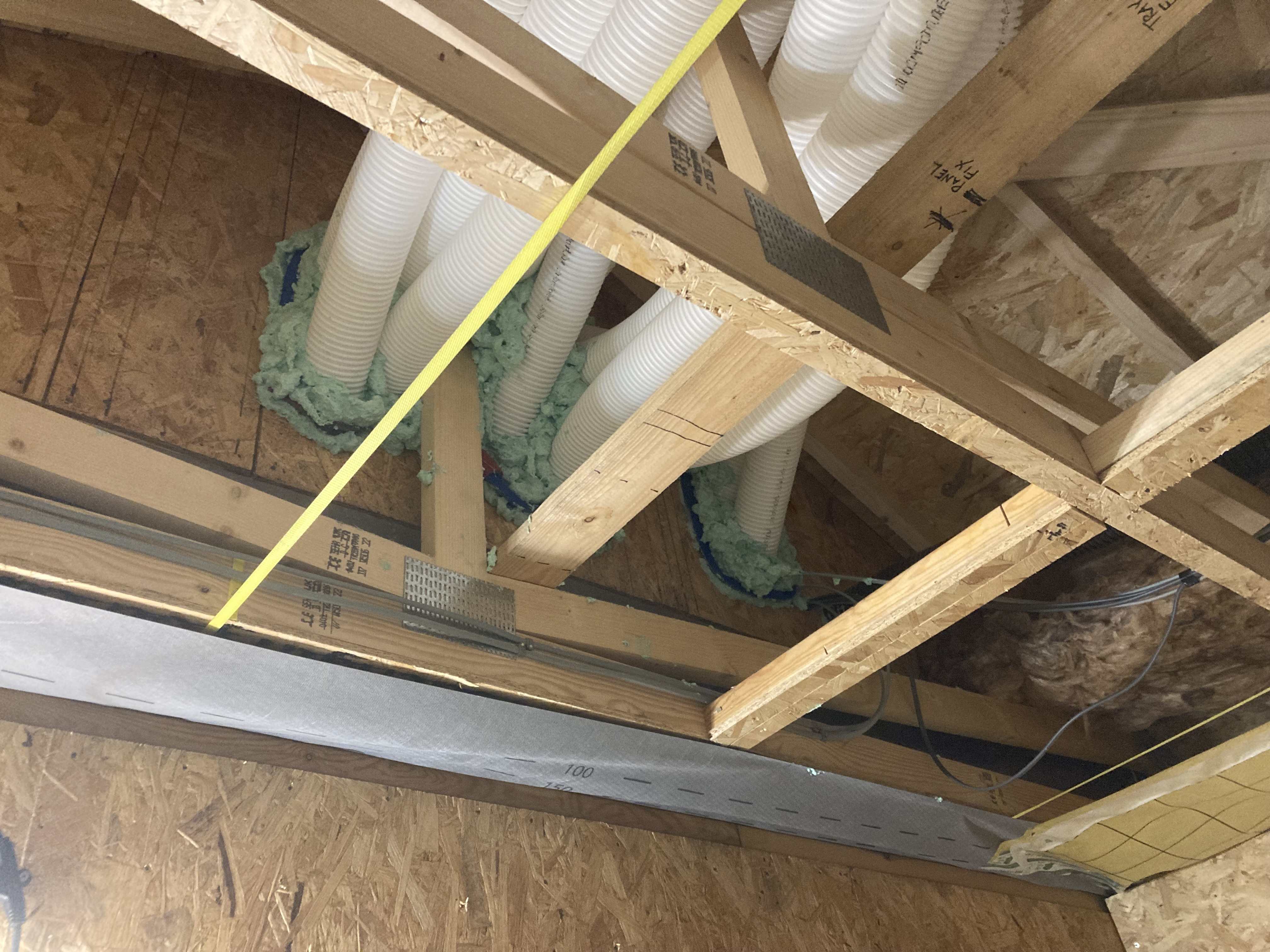
It wasn’t all bad news though. One bit that worked really well was taking all the ducts for upstairs straight up the front gable wall, with the ducts insulated but never passing through the VCL.
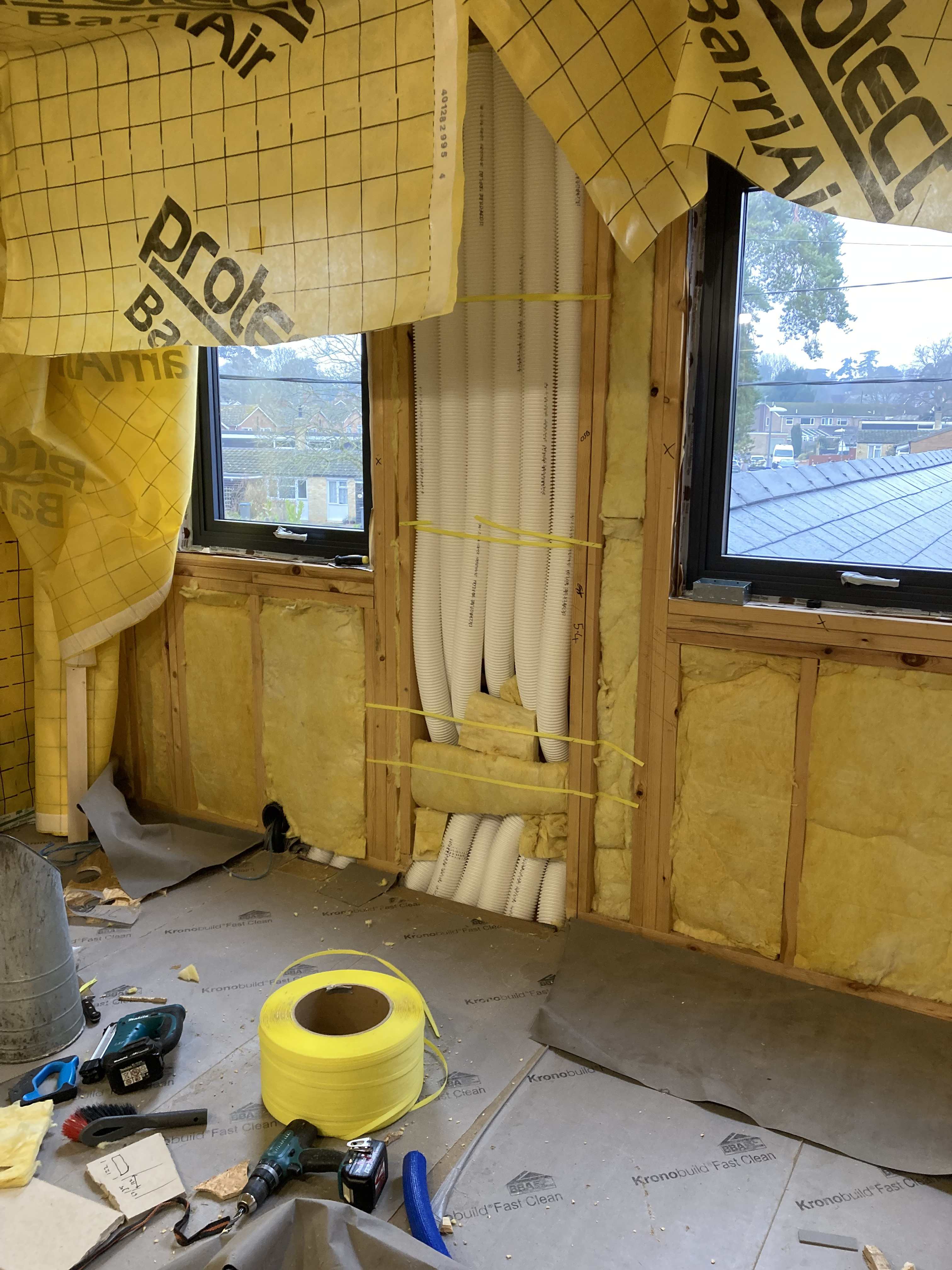
The bit that didn’t work was the downstairs ducts getting over the glulam. It meant they started their journey into the house with a tight s bend. The corrugated outer skin helped prevent the pipes pulling through the holes in the wall and floor that enabled them to dive down into the posi layer.
We also discovered a downside to our very heavily engineered joist plan above our main room. We are very keen to have nice, stiff floors upstairs with little movement. So we ended up with pairs of 147mm posis with only about 240mm gap between each pair. Looking at it there was literally more joist than gap. Felt good to walk on. Getting ducting through however…
On top of that we had a flue to avoid, and a barrier formed by two well insulated pipes that run from the UFH manifold to the cylinder via a diversion due to steelwork - another obvious bit that I failed to anticipate. Thank goodness the bookends (the guys doing the solar pv/inverter/battery/UFH/heat pump/UVC/etc.) suggested getting the cylinder in when they did. We call them bookends as either appear to be unable to work without the other. Odd world, innit.
So, with those pipes too in place it’s v congested in various areas. Much swearing and jumping up and down onto stepladders and skinned knuckles later and the vent pipes were done, with all 15 vent ducts poking out into the garage like some 1950s comedy alien being.
An alien that sits and waits, and when I walk past it it spits distilled water onto me. Seriously. Yet another ‘I’d never have imagined that’ moment.
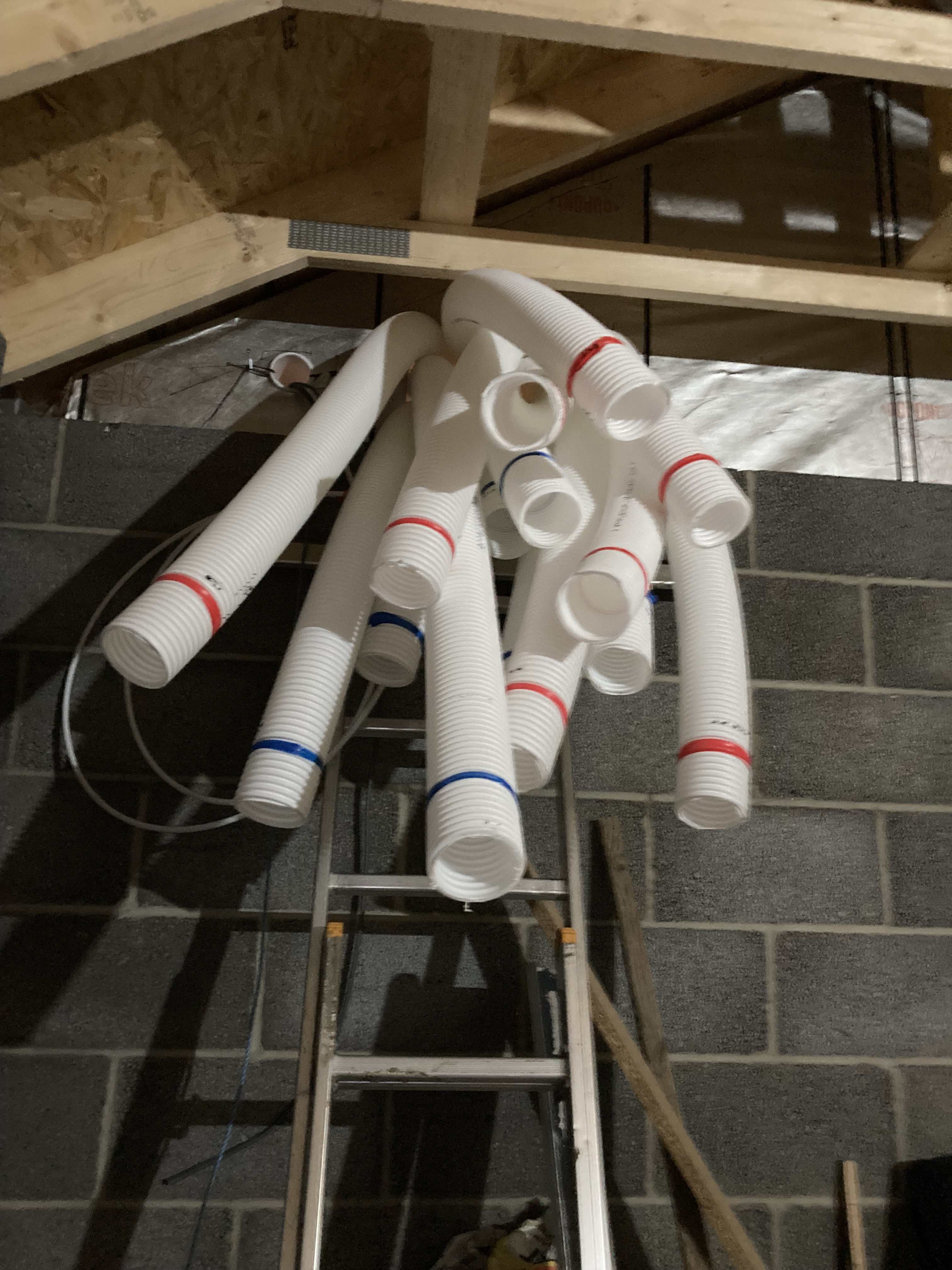
I'm guessing that the warm, wet air from the house is being sucked through all the vent pipes by the passing breezes. The garage is unheated. When that air hits the bit of the ducts in the garage some of the water vapour condenses onto the inner walls of the ducts. As I walk past I cause a disturbance which makes the condensation coalesce into droplets that then fall on me. What a fabulous illustration of how much an MVHR unit needs a drain.
Anyway, eventually, meaning two weeks later than hoped, we were ready for the tackers. I’d amassed a long list of ‘I’ll do that when the tackers are here’ tasks, oh my, will I never learn! To start with there was a constant stream of questions from the three guys. All of them reasonable, but they tended to be neatly timed so I’d just start picking up tools to do something myself when I distant “Geoff” would be heard so I’d put everything back down and toddle off to find which bit that particular tacker was staring at.
Originally we’d planned to put an OSB layer on all walls and the upstairs ceilings. I'd gone for raised tie trusses to reclaim some of the ceiling heights lost early in the design process. The idea was that the little sloped bit at the top of each wall would be hidden by the extra layer of studs and insulation. It was designed to the millimetre. Mistake.
The tackers assured me they would be careful of the ceiling VCL, and indeed they were. The few times they caught the VCL or when it needed easing they called me in to bring my repair tape. (Note to others - put spare VCL at corners, it’s so easy to make it too tight for the tackers). So they convinced us to ditch the ceiling OSB idea. Only if course, I’d factored in the thickness of the OSB into my calcs for the raised tie trusses.
So when the walls were boarded in a couple of places the roof bracing was just a tiny bit too low. I should have allowed a contingency but hey ho, double boarding the walls sorted it where needed. Fortunate to say the least.
Plasterboard changes the place. We’d spent weeks amongst soft, spongy walls, with insulation sitting behind and in front of the VCL. Very quiet. Lovely in fact. But plasterboard puts all the echo back and then some. Plus it finally shows the rooms for the shape and size they are. Sounds daft given how long we've spent in those rooms but seeing them plasterboarded was a bit of a shock in places.
The best example of that is the hallway. Drawing layouts and trying to imagine spaces only gets you so far. We designed in a double height space just inside the front door, nice straight stairs on one side. Bit of a sort of gallery on the other. But it’s huge. I knew all the dimensions by heart but I still didn’t know how big it was going to turn out. We are going to have to get creative to get it feeling right. Fortunately for me our principle aesthetics consultant (i.e. J) is brilliant, so I just know it’ll turn out well.
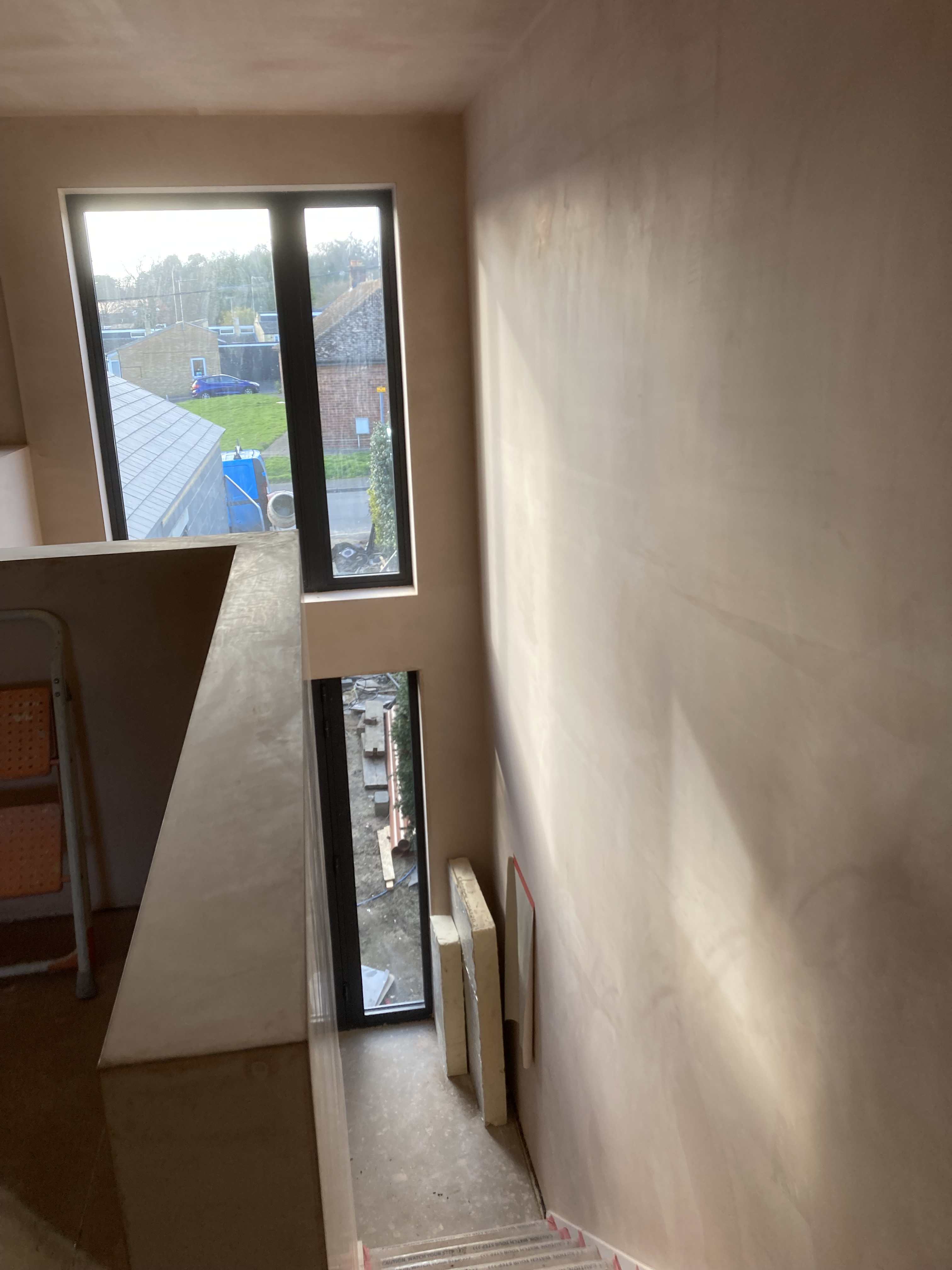
The plasterers were a dream. Tidy, polite, quiet (if you ignore Bananrama and Simply Red constantly playing in the background) and they also did a super job. A pleasure to work with. The only wrinkle was the ergovents. I installed them in their plenums precisely as per the instructions. What a shame I didn’t check with the plasterers first.
The instructions said the vents should be either flush or max 1mm below the plasterboard, which I super carefully did. The plasterers started when the upstairs was boarded, and they took one look at the vents and said “no”. They need 3mm to 4mm proud. Turns out the instructions are really targeted on the continent, where, apparently, they rarely skim. We skim. We need more depth.
Thank heavens downstairs hadn’t been boarded by then. All but one upstairs I could get to from the loft, slitting the VCL (I really must remember to go back and repair those slits) adjusting the brackets so they could be skimmed properly. The downstairs ones were easy to adjust, ahead of boarding.
The plaster has reduced the echo a bit, and as it’s drying and its colour gets lighter it’s given an even better impression of the rooms.
The plasterers were much less high maintenance giving Rolly and me time to put the wood cladding on the rear gable (massively more time consuming than expected) which meant that the three skylights could be fitted. Fantastic.
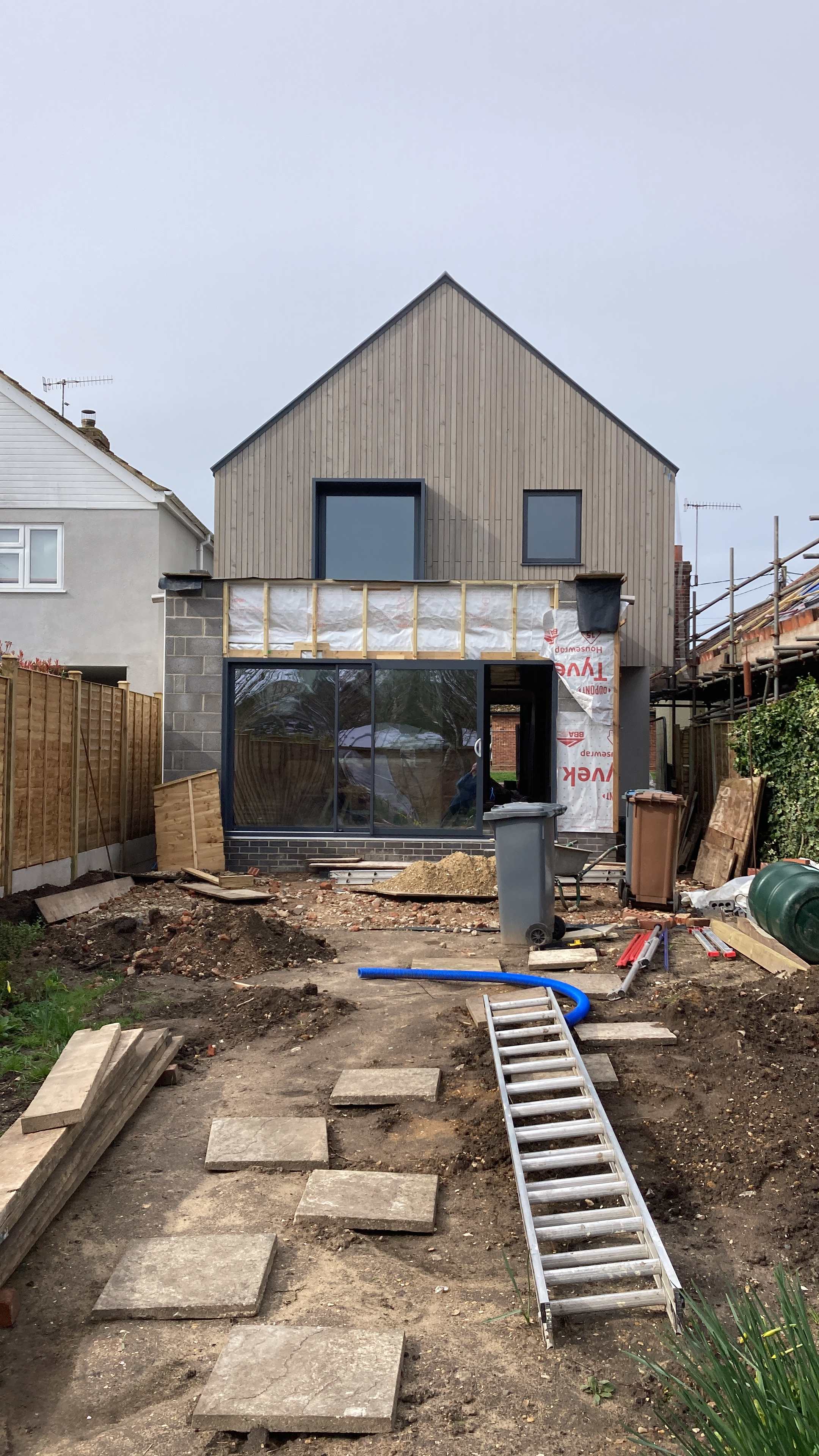
I borrowed a leaf blower from Rolly. The intention was to do a half arsed leak test using a temporary loft hatch. Never did get used, we never put the time aside, there was always a short term deadline hogging the priority. We'll find out in time whether it was needed. Another one for the ‘hope’ list.
0 Comments
Recommended Comments
There are no comments to display.
Create an account or sign in to comment
You need to be a member in order to leave a comment
Create an account
Sign up for a new account in our community. It's easy!
Register a new accountSign in
Already have an account? Sign in here.
Sign In Now